



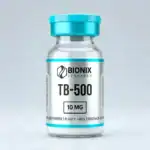
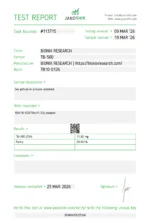

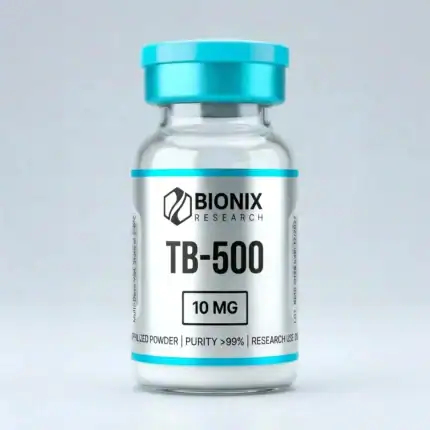
TB-500 (Thymosin Beta-4)
49,90 € Vial
5% off when paying with cryptocurrency
incl. VAT plus Shipping Costs
TB-500 Peptide 10mg – Thymosin Beta-4 Active Fragment for Cell Migration Research
- Synthetic heptapeptide corresponding to the active region (amino acids 17-23) of Thymosin Beta-4, functioning as an actin-sequestering peptide that regulates cytoskeletal dynamics.
- Studies demonstrate enhanced keratinocyte and endothelial cell migration through G-actin binding and cytoskeletal reorganization.
- Purity ≥99% (HPLC-verified). Supplied as lyophilized powder, 10mg per vial.
- Research applications include wound healing models, angiogenesis assays, cell migration studies, and tissue repair investigations.
- Store at -20°C. For research purposes only. Not intended for human consumption.
| Quantity | Price | Discount |
|---|---|---|
| 11-20 | 42,41 € Vial | 15% |
| 21+ | 39,92 € Vial | 20% |
Delivery time: 1–6 Working Days
TB-500 Peptide 10mg – Thymosin Beta-4 Fragment
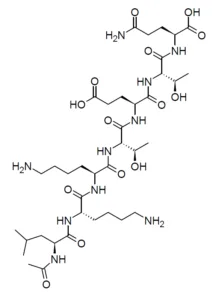
Chemical diagram for TB-500 source: https://en.wikipedia.org/wiki/TB-500#/media/File:TB-500_structure.png
KEY SPECIFICATIONS
| Parameter | Specification |
|---|---|
| Type | Synthetic heptapeptide (Tβ4 fragment) |
| Target | G-Actin (Globular Actin) |
| Sequence | Ac-Leu-Lys-Lys-Thr-Glu-Thr-Gln |
| Molecular Formula | C₃₈H₆₈N₁₀O₁₄ |
| Molecular Weight | 889.01 Da |
| CAS Number | 885340-08-9 |
| Parent Protein | Thymosin Beta-4 (Amino acids 17-23) |
| Stability Modification | N-terminal acetylation |
| Form | Lyophilized powder |
| Purity | ≥99% (HPLC) |
| Quantity | 10mg |
| Storage | -20°C |
PRODUCT OVERVIEW
TB-500 is a synthetic heptapeptide corresponding to the active region (amino acids 17-23) of Thymosin Beta-4 (Tβ4), a naturally occurring 43-amino acid polypeptide highly conserved across mammalian species. This fragment contains the essential actin-binding domain responsible for G-actin sequestration—the mechanism underlying Tβ4’s effects on cell migration, tissue repair, and angiogenesis. Research demonstrates TB-500 binds with high affinity to monomeric G-actin, preventing premature polymerization into F-actin filaments and maintaining a pool of unpolymerized actin for rapid cytoskeletal reorganization. Studies document enhanced keratinocyte and endothelial cell migration with effects comparable to full-length Tβ4. N-terminal acetylation protects against aminopeptidase degradation, enhancing bioavailability. BIONIX supplies TB-500 with ≥99% purity for cytoskeletal dynamics and tissue repair research.
MECHANISM OF ACTION
TB-500 functions as an actin-sequestering peptide, directly regulating cytoskeletal dynamics through high-affinity binding to monomeric G-actin.
G-Actin Sequestration Mechanism:
| Process | TB-500 Effect | Cellular Consequence | Research Application |
|---|---|---|---|
| G-actin binding | High-affinity monomer sequestration | Prevents premature F-actin formation | Actin pool maintenance |
| Polymerization regulation | Blocks spontaneous nucleation | Controlled filament assembly | Cytoskeletal dynamics |
| Depolymerization support | Enables rapid turnover | Dynamic remodeling | Migration assays |
| Migration enhancement | Promotes leading-edge protrusion | Enhanced cell motility | Wound healing models |
The actin cytoskeleton exists in dynamic equilibrium between G-actin (monomeric, soluble) and F-actin (filamentous, structural). TB-500 specifically binds G-actin monomers, maintaining availability for rapid reorganization.
Cell Migration Enhancement:
| Structure | TB-500 Function | Research Significance |
|---|---|---|
| Lamellipodium | Leading-edge actin polymerization | Directed cell migration |
| Filopodium | Exploratory projections | Environmental sensing |
| Cytoskeletal reorganization | Coordinated assembly/disassembly | Sustained motility |
| Focal adhesions | Adhesion turnover | Traction generation |
Angiogenic Effects:
| Process | TB-500 Contribution | Assay Application |
|---|---|---|
| Endothelial migration | Enhanced via actin dynamics | Scratch assays, Boyden chambers |
| Tube formation | Supported cell organization | Matrigel assays |
| Vessel sprouting | Promoted tip cell migration | Aortic ring assays |
| Vascular network | Enhanced branching | CAM assays |
Studies demonstrate TB-500 increases endothelial cell migration and accelerates tube formation in Matrigel assays—effects directly correlated with G-actin sequestration activity.
Comparison to Full Thymosin Beta-4:
| Parameter | TB-500 (Fragment 17-23) | Full Thymosin Beta-4 |
|---|---|---|
| Amino Acids | 7 | 43 |
| Molecular Weight | 889.01 Da | 4,963 Da |
| Primary Mechanism | G-actin sequestration | G-actin sequestration + additional domains |
| Stability | Enhanced (N-acetylation) | Lower stability |
| Synthesis | Simpler | More complex |
| Handling | Easier reconstitution | More challenging |
| Actin-Binding Activity | Retained | Full activity |
| Research Focus | Preclinical cytoskeletal | Broader clinical |
TB-500 retains essential actin-binding activity while offering practical advantages for laboratory research.
Proposed Mechanism Pathway:
TB-500 → G-Actin Binding → Monomer Sequestration → Actin Pool Maintenance →
Lamellipodia/Filopodia Formation → Cell Migration Enhancement /
Endothelial Cell Migration → Tube Formation → Angiogenesis Support
RESEARCH APPLICATIONS
• Wound Healing Models: Primary application for investigating cellular mechanisms of wound repair. Keratinocyte migration studies via scratch assays (wound closure rates), Boyden chambers (chemotactic response), time-lapse imaging (velocity, directionality), and proliferation assays (BrdU incorporation). Fibroblast studies examining migration rates, collagen synthesis, extracellular matrix deposition, and myofibroblast differentiation. Experimental endpoints: wound closure percentage, re-epithelialization, granulation tissue formation, tensile strength.
• Angiogenesis Research: Extensive use in vascular formation assays. In vitro models: tube formation (Matrigel—network complexity, branch points), endothelial migration (cells migrated, velocity), proliferation (cell number), sprouting (3D—sprout length, number). Ex vivo: aortic ring sprouting assays, retinal explant vascularization. In ovo: chorioallantoic membrane (CAM) assays for vessel density and branching quantification. Investigation of whether G-actin sequestration directly correlates with angiogenic capacity.
• Cytoskeletal Dynamics Studies: Molecular tool for actin biology investigation. Actin visualization: phalloidin staining (F-actin), G-actin/F-actin ratio quantification, live-cell dynamics imaging, fluorescent actin incorporation. Molecular analysis: actin polymerization assays (pyrene-actin), G-actin sequestration measurements, cofilin/profilin activity assessment, Rho GTPase pathway analysis. Investigation of actin turnover kinetics and filament organization.
• Inflammation Research: Anti-inflammatory properties investigated in various models: cytokine profiling (TNF-α, IL-6, IL-1β), inflammatory cell infiltration quantification, resolution phase marker analysis, macrophage polarization studies. Effects partially attributed to cytoskeletal changes influencing immune cell function and cytokine secretion.
• Analytical Method Development: TB-500 metabolism and detection active research areas: UHPLC-MS/MS method development, metabolite identification (Ac-LKKTE and others), adsorption characterization, doping control applications, pharmacokinetic profiling. PMID 38382158 documents simultaneous quantification of TB-500 and metabolites.
ANALYTICAL VERIFICATION
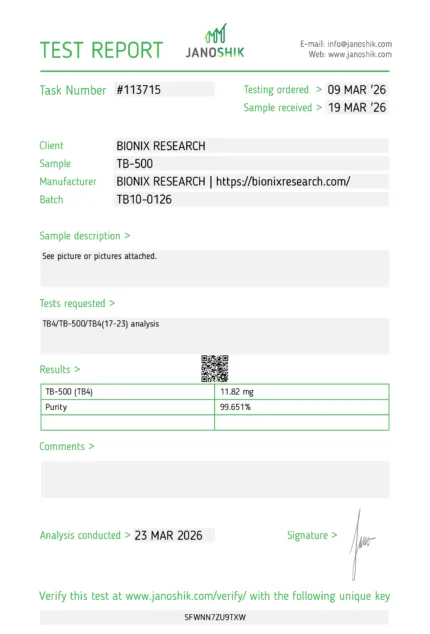
BIONIX TB-500 undergoes comprehensive analytical characterization:
• HPLC Analysis: Gradient separation confirms ≥99% purity; separates heptapeptide from impurities and synthesis byproducts • Mass Spectrometry: Exact molecular weight confirmation (889.01 Da) and Ac-LKKTETQ sequence verification including N-terminal acetylation • Amino Acid Analysis: Leu-Lys-Lys-Thr-Glu-Thr-Gln composition quantification • N-Terminal Modification Verification: Acetylation confirmation (stability feature) • Endotoxin Testing: LAL assay for cell culture applications
Physical Characteristics:
| Property | Specification |
|---|---|
| Appearance | White to off-white lyophilized powder |
| Molecular Weight | 889.01 Da |
| Sequence | Ac-Leu-Lys-Lys-Thr-Glu-Thr-Gln |
| Amino Acids | 7 residues |
| Parent Origin | Thymosin Beta-4 (residues 17-23) |
| Stability Feature | N-terminal acetylation |
| Solubility | Water soluble |
| Purity | ≥99% (HPLC-verified) |
DEVELOPMENT STATUS
• Origin: Synthetic heptapeptide fragment of Thymosin Beta-4 (amino acids 17-23); contains essential actin-binding domain • Research History: Extensive investigation in wound healing, angiogenesis, and cytoskeletal dynamics; emerging analytical method development • Mechanism: G-actin sequestration through LKKTETQ sequence; prevents premature F-actin polymerization • Clinical Status: Not FDA or EMA approved; research compound only • Recent Research: 2024 UHPLC-MS/MS metabolite identification (PMID 38382158); adsorption characterization (PMID 28887173); doping control methods (PMID 24906629) • WADA Status: Research compound with doping control analytical methods established (verify current prohibited list)
BIONIX TB-500 is supplied exclusively for laboratory research purposes—not for therapeutic use, human administration, veterinary, or clinical applications.
FREQUENTLY ENCOUNTERED INQUIRIES
How does TB-500 differ from full Thymosin Beta-4?
TB-500 is the active heptapeptide fragment (amino acids 17-23) of the complete 43-amino acid Thymosin Beta-4 protein. Research demonstrates this fragment retains the essential actin-binding activity of the full protein while offering improved stability through N-terminal acetylation and simplified handling due to smaller size (889 Da vs. 4,963 Da). The fragment contains the core LKKTETQ sequence responsible for G-actin sequestration, making it functionally equivalent for actin-related research applications with enhanced practical usability.
What is TB-500’s mechanism of action?
TB-500 enhances cell migration through G-actin sequestration. By binding to monomeric G-actin with high affinity, the peptide maintains a pool of unpolymerized actin available for rapid cytoskeletal reorganization. This enables efficient formation of lamellipodia (leading-edge protrusions) and filopodia (exploratory projections)—cellular structures essential for directed migration. The regulated G-actin/F-actin equilibrium supports coordinated actin polymerization at the leading edge and depolymerization at the trailing edge of migrating cells.
What research models is TB-500 used in?
Primary applications: wound healing models (keratinocyte and fibroblast migration assays, scratch assays, closure kinetics), angiogenesis assays (tube formation, endothelial migration, aortic ring sprouting, CAM assays), cytoskeletal dynamics studies (actin visualization, polymerization assays, Rho GTPase analysis), inflammation research (cytokine profiling, macrophage polarization), and analytical method development (UHPLC-MS/MS, metabolite identification, doping control). All applications restricted to controlled laboratory environments.
What reconstitution method is recommended?
Reconstitute lyophilized powder with bacteriostatic water under sterile conditions. Typical research concentrations: 0.1-1 mg/ml for in vitro experiments. Allow vial to reach room temperature before opening, add solvent gently, swirl until dissolved—avoid vortexing. Reconstituted solution should be aliquoted immediately and stored at -20°C (1-3 months) or -80°C (6-12 months). Working aliquots kept at 2-8°C and used within 7 days.
How stable is TB-500?
N-terminal acetylation significantly enhances stability compared to unmodified fragments by protecting against aminopeptidase degradation. Lyophilized form at -20°C: stable up to 24 months. Post-reconstitution: aliquoted solutions maintain activity 1-3 months at -20°C or 6-12 months at -80°C. Working solutions at 2-8°C: use within 7 days. This stability profile enables extended research protocols without degradation concerns affecting reproducibility.
Is TB-500 approved for clinical use?
Negative. TB-500 is a research compound derived from Thymosin Beta-4, not FDA or EMA approved for therapeutic indications. It is investigated exclusively in preclinical and in vitro models for understanding actin dynamics, cell migration, and tissue repair mechanisms. Analytical methods for detection have been developed for doping control purposes (PMID 24906629). BIONIX supplies research-grade material for laboratory use only—not for human therapeutic application.
REFERENCES
- PMID: 38382158 — Simultaneous quantification of TB-500 and metabolites by UHPLC-Q-Exactive orbitrap MS/MS (J Chromatogr B, 2024)
- PMID: 28887173 — Adsorption effects of TB-500 and other doping-relevant peptides (Anal Biochem, 2017)
- PMID: 24906629 — Analytical approaches for detection in human doping controls (J Pharm Biomed Anal, 2014)
- PMID: 15037014 — Thymosin β4 promotes angiogenesis and wound healing (Mech Ageing Dev, 2004)
- Goldstein AL, Kleinman HK., 2015 — Thymosin β4: Actin-sequestering protein repairs injured tissues (Trends Mol Med)
- PMC, 2021 — Utilizing Thymosin Beta-4 to remind adult organs of embryonic state
| Dosage | 10mg, 20mg, 40mg, 50mg, 5mg |
|---|
Product safety
Safety instructions
SAFETY DATA SHEET (SDS)
TB-500 Peptide – Research-Grade Lyophilized Powder (RUO)
CAS Number: 885340-08-9
Synonyms: Thymosin Beta-4 Fragment 17-23, Ac-Leu-Lys-Lys-Thr-Glu-Thr-Gln
REACH Registration: Exempt (<1 tonne/year; Research Use Only)
SECTION 1 — Identification
1.1 Product Identifier: TB-500 Peptide – Lyophilized Powder
1.2 Identified Uses: Analytical-grade peptide for in-vitro laboratory research. Research Use Only (RUO). Not for human or veterinary use.
1.3 Supplier: BIONIX RESEARCH
Email: info@bionixresearch.com
1.4 Emergency: EU Emergency Number: 112
SECTION 2 — Hazards Identification
2.1 Classification: Not classified as hazardous under CLP Regulation (EC) 1272/2008. No GHS pictograms required.
2.2 Precautionary notes:
- Avoid dust inhalation
- Avoid contact with eyes
- Laboratory use only
SECTION 3 — Composition
Substance: TB-500 Peptide
CAS: 885340-08-9
Purity: ≥99% HPLC
Form: Lyophilized powder
Impurities: None classified as hazardous.
SECTION 4 — First-Aid Measures
Inhalation: Move to fresh air. Rinse mouth and nose.
Skin Contact: Wash thoroughly with water and soap.
Eye Contact: Rinse cautiously with clean water for several minutes.
Ingestion: Rinse mouth. Do not induce vomiting. Seek medical advice.
SECTION 5 — Fire-Fighting Measures
Extinguishing Media: CO₂, dry chemical, foam, or water spray.
Hazards: Organic peptide powder, non-flammable. Thermal decomposition may release CO, CO₂, nitrogen oxides.
SECTION 6 — Accidental Release Measures
Avoid dust formation. Use gloves, mask, protective eyewear. Collect powder into sealed waste container.
SECTION 7 — Handling and Storage
Handling: Use only in laboratory settings. Minimize dust formation. Wear standard PPE.
Storage: Store at −20 °C in sealed vial. Protect from sunlight and humidity. Research use only.
SECTION 8 — Exposure Controls / Personal Protection
Exposure Limits: None established.
PPE: Nitrile or latex gloves, lab coat, protective eyewear, dust mask when handling powders.
SECTION 9 — Physical and Chemical Properties
Appearance: White to off-white lyophilized powder
Odor: None
Solubility: Soluble in sterile water, dilute acids, or aqueous buffers
Stability: Stable when stored at −20 °C
SECTION 10 — Stability and Reactivity
Stable under recommended conditions. Avoid heat, moisture, air exposure, oxidizing agents.
SECTION 11 — Toxicological Information
No data available for human exposure. Low acute toxicity expected. Dust may cause mild irritation. Not intended for injection, ingestion, or topical use.
SECTION 12 — Ecological Information
No data available. Not expected to present environmental risks. Prevent release into water systems.
SECTION 13 — Disposal Considerations
Dispose according to local regulations for laboratory chemical waste. Do not dispose via household waste or sewer systems.
SECTION 14 — Transport Information
Not regulated under ADR, IMDG, IATA. No UN classification required.
SECTION 15 — Regulatory Information
Not subject to REACH registration (<1 tonne/year; RUO exemption). Not classified under CLP. Not a pharmaceutical, cosmetic, or medical product.
SECTION 16 — Other Information
This SDS is intended for trained laboratory personnel. It does not signify suitability for therapeutic, diagnostic, or consumer applications.
Frequently bought together

You may also like…

BPC-157 & TB-500 Blend (Wolverine Stack)
49,90 € Vialincl. VAT
plus Shipping Costs
Delivery time: 1–6 Working Days
Related products

Bacteriostatic (BAC) Water
9,90 € Vialincl. VAT
plus Shipping Costs
Delivery time: 1–6 Working Days
BPC-157
24,90 € Vialincl. VAT
plus Shipping Costs
Delivery time: 1–6 Working Days
CJC-1295 No DAC
54,90 € Vialincl. VAT
plus Shipping Costs
Delivery time: 1–6 Working Days
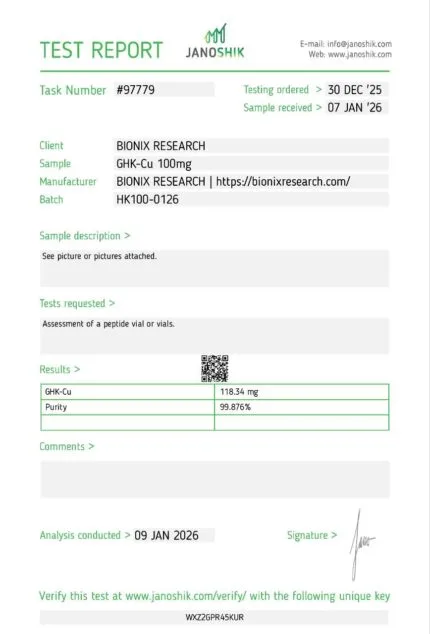
GHK-Cu
29,90 € Vialincl. VAT
plus Shipping Costs
Delivery time: 1–6 Working Days
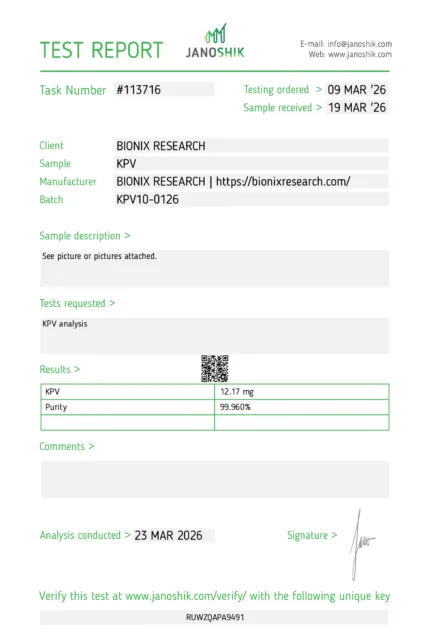
KPV
34,90 € Vialincl. VAT
plus Shipping Costs
Delivery time: 1–6 Working Days

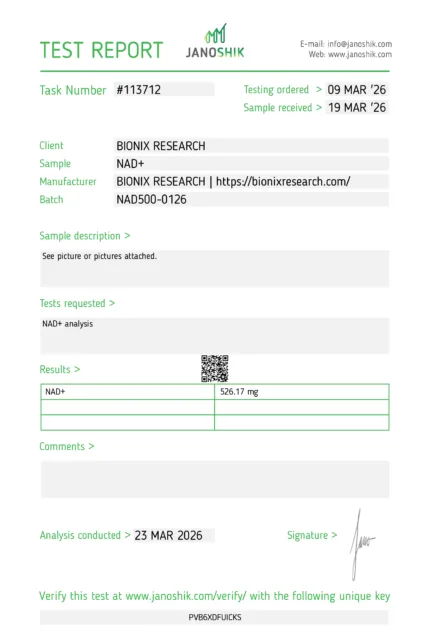
NAD+
59,90 € Vialincl. VAT
plus Shipping Costs
Delivery time: 1–6 Working Days
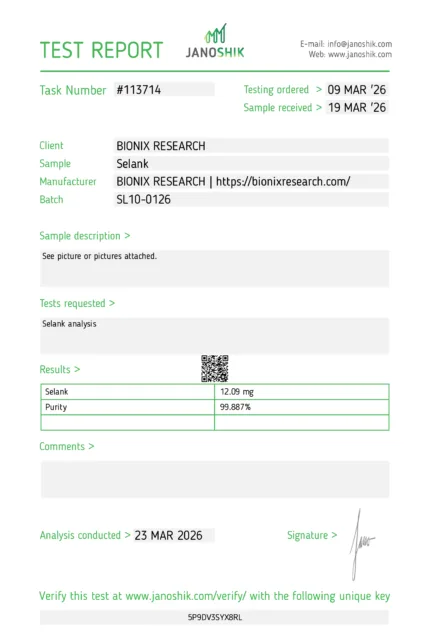
Selank
29,90 € Vialincl. VAT
plus Shipping Costs
Delivery time: 1–6 Working Days
SS-31 (Elamipretide) Peptide
49,90 € Vialincl. VAT
plus Shipping Costs
Delivery time: 1–6 Working Days

