


Knowledge Base
What is GHK-Cu? The Copper Peptide That Modulates 4,000+ Genes

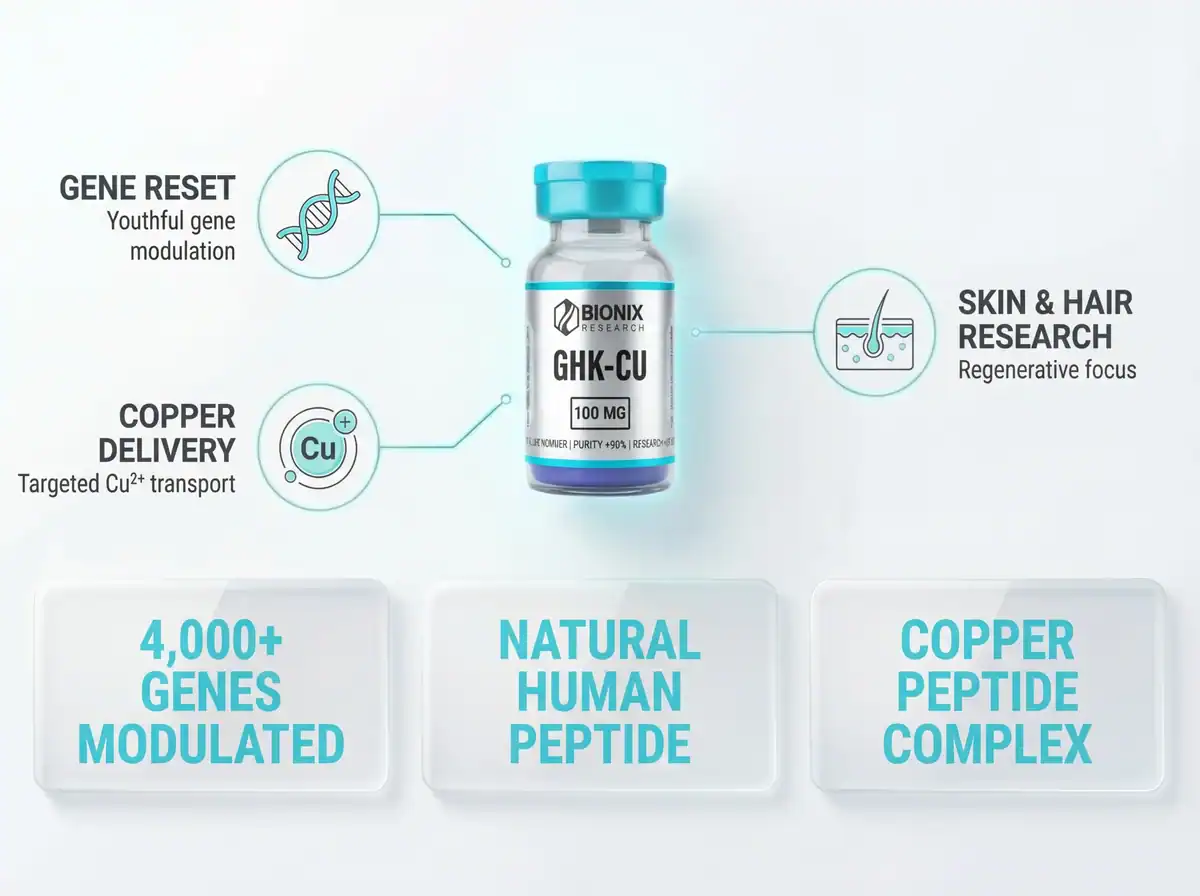
GHK-Cu Peptide: The Complete Guide to Copper-Powered Skin Regeneration [2026]
Key Takeaways: GHK-Cu at a Glance
| Property | Details |
|---|---|
| Full Name | Glycyl-L-Histidyl-L-Lysine Copper Complex |
| Classification | Naturally occurring copper-binding tripeptide |
| Molecular Weight | 403.9 g/mol |
| Natural Occurrence | Human blood plasma (~200 ng/mL at age 20) |
| Primary Mechanisms | Gene modulation, copper transport, collagen stimulation |
| Research Focus | Anti-aging, wound healing, hair growth, neuroprotection |
Research Use Only:
GHK-Cu as a pure substance is intended exclusively for research purposes and is not approved for human consumption or direct application. Cosmetic formulations containing GHK-Cu (often labeled "Copper Tripeptide-1") are subject to different regulations. All information serves educational purposes only.
The peptide revolution is happening now
Unlock the Advantage: Biological Optimization & Longevity Research Peptides
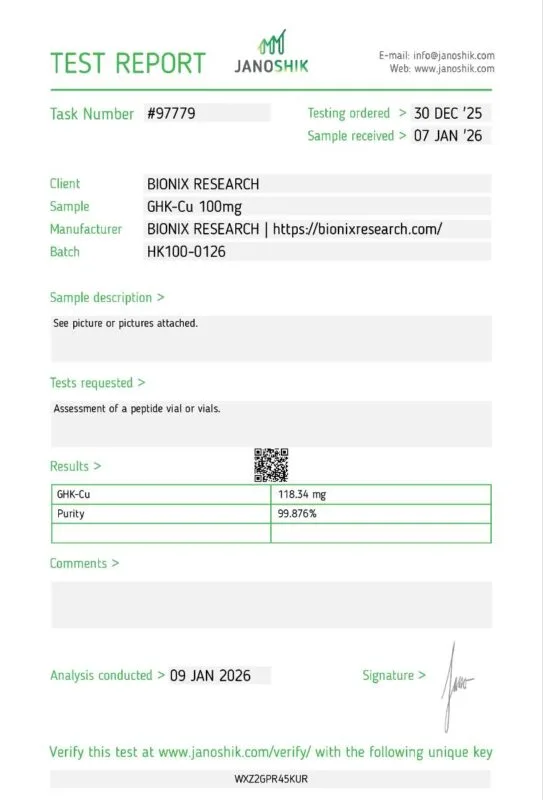
GHK-Cu
29,90 € Vialincl. VAT
plus Shipping Costs
Delivery time: 1–6 Working Days
The Biological "Reset Switch" Your Skin Loses With Age
At age 20, your blood contains approximately 200 ng/mL of a tiny copper-carrying molecule. By 60, that number drops to just 80 ng/mL—a 60% decline that correlates directly with visible aging: thinner skin, slower wound healing, less collagen.
That molecule is GHK-Cu, and researchers have discovered it can influence the expression of over 4,000 human genes, shifting them toward patterns associated with younger, healthier tissue.
Unlike synthetic compounds designed in laboratories, GHK-Cu is something your body already produces. The question researchers are asking: what happens when declining levels are supplemented?
In this comprehensive guide, you'll discover:
- The molecular architecture of GHK-Cu and why copper binding matters
- Three distinct mechanisms of action at the cellular level
- 2025 research breakthroughs including ulcerative colitis and hydrogel delivery systems
- Evidence quality across different research areas
- Why application method dramatically affects outcomes
What Is GHK-Cu? Molecular Identity Explained
The Two Components
GHK-Cu is a complex of two essential parts:
GHK (Glycyl-Histidyl-Lysine)
- A tripeptide: three amino acids linked together
- The "taxi" that carries copper to cells
Cu²⁺ (Copper Ion)
- The essential "passenger" delivered to target tissues
- Activates copper-dependent enzymes upon arrival
The Three Amino Acid Building Blocks
| Amino Acid | Abbreviation | Function |
|---|---|---|
| Glycine | G | Smallest amino acid, provides structural flexibility |
| Histidine | H | Contains imidazole ring that binds copper with exceptional strength |
| Lysine | K | Positively charged, facilitates cellular uptake |
The sequence arrangement creates a binding pocket perfectly shaped for copper ions—a molecular design refined by evolution over millions of years.
Extraordinarily High Copper Affinity
What makes GHK special isn't just that it binds copper—many peptides do. It's how strongly it binds.
GHK's copper affinity is so high that it can "steal" copper from other proteins and redirect it to cells that need it most. This makes GHK-Cu function as a highly specific copper shuttle, delivering this essential trace element precisely where it's needed for repair and regeneration.
Molecular weight: 403.9 g/mol—small enough to penetrate deep into tissue layers when properly formulated.
Natural Occurrence and Age-Related Decline
GHK-Cu isn't a synthetic invention. It circulates naturally in your blood plasma, saliva, and urine. But production doesn't remain constant:
| Age | Plasma Concentration | Relative Level |
|---|---|---|
| 20 years | ~200 ng/mL | 100% (baseline) |
| 40 years | ~140 ng/mL | 70% |
| 60 years | ~80 ng/mL | 40% |
This decline correlates with:
- Reduced collagen production
- Thinner dermis (skin's structural layer)
- Slower wound healing
- Decreased antioxidant enzyme activity
The correlation has driven decades of research into whether supplementation can reverse these age-related changes.
How Does GHK-Cu Work? Three Mechanisms of Action
GHK-Cu operates through three distinct but interconnected pathways.
1. Gene Modulation: The "Software Update"
GHK-Cu influences the activity of over 4,000 human genes—approximately 6% of the entire human genome.
Pattern observed: Genes associated with tissue repair and regeneration are upregulated, while genes associated with inflammation and degeneration are downregulated.
Key pathways affected:
- SIRT1 signaling: Longevity-associated pathway linked to cellular stress resistance
- TGF-β pathway: Master regulator of tissue repair and fibrosis
- Antioxidant response: Increased expression of protective enzymes
Analogy: If your cells are running outdated software causing inefficient operation, GHK-Cu acts like a firmware update—the hardware remains the same, but performance improves.
2. Copper Transport: The Delivery System
Copper is an essential trace element required for:
- SOD (Superoxide Dismutase): One of the body's most powerful antioxidant enzymes
- Lysyl oxidase: Required for collagen and elastin cross-linking
- Cytochrome c oxidase: Essential for cellular energy production
- Tyrosinase: Involved in melanin production
The problem: Free copper ions can be toxic. The body requires sophisticated transport systems to deliver copper safely.
GHK-Cu's role: Acts as a highly specific copper courier, binding the ion tightly during transport and releasing it precisely at target cells.
Analogy: A courier who delivers construction materials directly to the building site—not just to the street corner.
3. Extracellular Matrix Stimulation: Rebuilding the Foundation
The extracellular matrix (ECM) is the structural scaffold between cells. In skin, it consists primarily of:
- Collagen Type I: Provides tensile strength
- Elastin: Provides flexibility and rebound
- Glycosaminoglycans: Retain moisture
GHK-Cu stimulates fibroblasts—the cells responsible for producing ECM components—through TGF-β pathway activation.
Observed effects:
- Increased collagen Type I synthesis
- Enhanced elastin production
- Improved ECM organization
Analogy: Strengthening the foundation of a building—the entire structure becomes more stable.
Mechanism Summary Table
| Mechanism | Molecular Action | Functional Outcome |
|---|---|---|
| Gene Modulation | Alters expression of 4,000+ genes | Cellular behavior shifts toward "younger" patterns |
| Copper Transport | Delivers Cu²⁺ to target cells | Activates SOD, lysyl oxidase, and other enzymes |
| ECM Stimulation | Activates TGF-β → fibroblast stimulation | Increased collagen/elastin, improved skin density |
Latest Research: What 2024-2025 Studies Reveal
Ulcerative Colitis Model (July 2025)
A groundbreaking study published in Frontiers in Pharmacology demonstrated GHK-Cu's therapeutic effects in DSS-induced ulcerative colitis in mice:
- Mucosal healing promotion
- Tight junction enhancement (barrier function)
- SIRT1 pathway activation for anti-inflammatory effects
- Target identification: REN and OXTR genes identified as key mediators
Significance: This expands GHK-Cu research beyond dermatology into gastrointestinal applications, suggesting broader regenerative potential.
Self-Healing Hydrogel Technology (February 2025)
Research published in PMC introduced a novel food-derived tripeptide-copper hydrogel system:
- Sustained release: 62% cumulative release at 96 hours
- Infected wound healing: Demonstrated efficacy in contaminated wound models
- Stability enhancement: Hydrogel formulation protects peptide integrity
Application: This delivery innovation may solve the stability challenges that have limited GHK-Cu's practical applications.
Gene Expression Patterns (2024)
Analysis confirms GHK's ability to reset gene expression toward healthier states:
- Apoptosis promotion for damaged cells
- Inflammation suppression pathways activated
- Age-prevention effects at the transcriptomic level
Clinical Study Reference (2018)
The most cited human trial involved 71 women applying GHK-Cu facial cream daily for 12 weeks:
- Increased skin thickness
- Reduced visible aging signs
- Improved elasticity measurements
Evidence Quality Assessment
| Research Area | Evidence Level | Key Findings | Limitations |
|---|---|---|---|
| Skin Anti-Aging | Clinical (limited) | Thickness increase, wrinkle reduction | Small sample sizes |
| Wound Healing | Preclinical (strong) | Accelerated closure, reduced scarring | Few human trials |
| Hair Growth | Preclinical/cosmetic | Follicle enlargement, anagen prolongation | Mechanistic studies lacking |
| Neuroprotection | Preclinical (emerging) | NGF promotion, anxiety reduction | Early-stage |
| GI Applications | Preclinical (2025) | Mucosal healing in UC models | Animal models only |
Research Applications by Area
1. Skin Rejuvenation (Anti-Aging)
Observed effects in studies:
- Measurable increase in skin density and elasticity
- Reduction in fine lines and wrinkles
- Improved hydration retention
- Enhanced skin barrier function
Proposed mechanisms:
- Collagen Type I and III synthesis stimulation
- Elastin production enhancement
- Antioxidant enzyme activation via copper delivery
- Inflammatory cytokine suppression
2. Wound Healing
Preclinical observations:
- Accelerated wound closure rates
- Enhanced fibroblast migration to wound edges
- Increased angiogenesis (new blood vessel formation)
- Reduced scar tissue formation through collagen remodeling
Diabetic wound models: GHK-Cu incorporated into collagen dressings showed faster closure compared to controls.
3. Hair Growth
In vitro and animal data:
- Follicular keratinocyte stimulation
- Hair follicle enlargement
- Extended anagen (growth) phase
- Improved scalp microcirculation
- Reduced follicular inflammation
4. Neuroprotection
Emerging research suggests:
- NGF (Nerve Growth Factor) secretion promotion
- Axon regeneration support after injury
- Rapid anxiolytic effects (observed within 12 minutes in rat models)
Administration Methods: Topical vs. Injectable
The delivery method fundamentally determines where GHK-Cu exerts its effects.
Topical Application (Creams, Serums)
| Aspect | Details |
|---|---|
| Primary Use | Localized skin effects, hair growth |
| Penetration | Limited to epidermis and upper dermis |
| Systemic Effects | Minimal |
| Formulation Concentrations | 0.001% to 3% (wide variation in studies) |
| Stability Challenges | Copper can oxidize, requiring careful formulation |
Innovations: Liposomal encapsulation and hydrogel systems (2025) show improved penetration and stability.
Subcutaneous Injection
| Aspect | Details |
|---|---|
| Primary Use | Systemic regeneration research, wound healing studies |
| Bioavailability | Higher than topical |
| Systemic Effects | Present |
| Research Status | Limited human data |
Cosmetic vs. Research Grade
Important distinction:
- Cosmetic formulations (often labeled "Copper Tripeptide-1"): Regulated as cosmetics, available commercially
- Research-grade GHK-Cu: Pure substance for laboratory research only, not approved for human application
Safety Profile and Considerations
Preclinical Safety Data
GHK-Cu demonstrates a favorable safety profile in research:
- Cell viability: No significant loss at concentrations up to 62.5 μmol/L
- Allergic reactions: Rare in topical formulations
- Acute toxicity: Not observed at typical research concentrations
Theoretical Concerns
| Concern | Rationale | Current Evidence |
|---|---|---|
| Copper overload | Excess copper can be toxic | Not observed at research concentrations |
| Angiogenesis promotion | Could theoretically support tumor growth | No evidence of tumor promotion in studies |
| Long-term effects | Limited data beyond months | Unknown |
What We Don't Know
- Long-term safety in humans with continuous use
- Optimal concentration thresholds
- Interactions with other active ingredients
- Effects in specific populations (pregnant, immunocompromised)
GHK-Cu vs. Other Copper Peptides
| Peptide | Structure | Primary Research Focus |
|---|---|---|
| GHK-Cu | Gly-His-Lys + Cu²⁺ | Anti-aging, wound healing, gene modulation |
| AHK-Cu | Ala-His-Lys + Cu²⁺ | Hair growth (similar to GHK-Cu) |
| Copper Tripeptide-1 | Commercial name for GHK-Cu | Cosmetic applications |
| Free Copper Peptides | Various sequences | Research varies widely |
GHK-Cu's distinction: The highest copper binding affinity and most extensive research documentation among copper peptides.
Open Scientific Questions
| Question | Current Status |
|---|---|
| Optimal concentration for each application? | Studies range from 0.001% to 3%—no consensus |
| How to maximize penetration into deeper skin layers? | Hydrogel and liposomal formulations under investigation |
| Long-term effects of continuous supplementation? | Data limited to weeks/months |
| Interaction with endogenous GHK-Cu production? | Unknown if supplementation affects natural synthesis |
| Standardized protocols for specific applications? | Not established |
Research Context & Limitations
Evidence Hierarchy
Most GHK-Cu evidence comes from:
- In vitro studies (cell cultures)
- Animal models (primarily rodents)
- Small-scale human trials (cosmetic applications)
Large-scale randomized controlled trials: Largely absent
Regulatory Status
| Region | Status |
|---|---|
| Cosmetic Use (Copper Tripeptide-1) | Permitted in cosmetics globally |
| Research Chemical (GHK-Cu pure) | Research Use Only |
| Pharmaceutical Approval | None in any major jurisdiction |
Transferability Limitations
Findings from cell cultures and animal models don't automatically translate to human applications. The research provides promising signals, but definitive clinical evidence remains limited.
Summary
GHK-Cu is a naturally occurring copper-binding tripeptide that declines significantly with age. Research demonstrates its ability to:
- Modulate 4,000+ genes toward regenerative patterns
- Transport copper to activate essential enzymes
- Stimulate collagen and elastin synthesis
2025 research has expanded applications beyond dermatology into gastrointestinal healing, while hydrogel delivery innovations address historical stability challenges.
The evidence base is strongest for topical anti-aging applications, with promising preclinical data for wound healing, hair growth, and neuroprotection. Large-scale human clinical trials remain the critical missing piece.
The peptide revolution is happening now
Unlock the Advantage: Biological Optimization & Longevity Research Peptides
GHK-Cu
29,90 € Vialincl. VAT
plus Shipping Costs
Delivery time: 1–6 Working Days
Frequently Asked Questions
What exactly is GHK-Cu?
GHK-Cu is a tripeptide (three amino acids: Glycine, Histidine, Lysine) bound to a copper ion (Cu²⁺). It occurs naturally in human blood plasma and functions as a copper transporter while modulating gene expression.
How does GHK-Cu differ from pure copper supplements?
Pure copper ions can be toxic in excess. GHK-Cu provides copper in a bound, controlled form that delivers the ion precisely to cells that need it—like a guided delivery system versus flooding the area.
Why does GHK-Cu concentration decrease with age?
The body's natural production declines over the lifespan. At age 20, plasma concentration averages ~200 ng/mL; by 60, it drops to ~80 ng/mL. This correlates with visible aging markers like reduced collagen and slower healing.
What's the difference between GHK-Cu and Copper Tripeptide-1?
They're the same molecule. "Copper Tripeptide-1" is the INCI (International Nomenclature of Cosmetic Ingredients) name used in cosmetic product labeling.
Can GHK-Cu be taken orally?
Oral bioavailability is poor due to peptide degradation in the digestive tract. Research focuses on topical and injectable routes.
Is GHK-Cu safe?
Preclinical data shows a favorable safety profile at research concentrations. However, long-term human safety data is limited. Cosmetic formulations have extensive use history without significant adverse event reports.
How does GHK-Cu compare to retinoids for anti-aging?
Different mechanisms: Retinoids primarily affect cell turnover and vitamin A receptor pathways, while GHK-Cu modulates broader gene expression patterns and provides copper for enzyme activation. Some researchers study them in combination.
Glossary
| Term | Definition |
|---|---|
| Tripeptide | Molecule consisting of three amino acids linked together |
| Collagen | Structural protein providing tensile strength to skin and connective tissues |
| Elastin | Protein enabling tissue flexibility and elastic recoil |
| Fibroblasts | Cells that produce collagen, elastin, and other ECM components |
| ECM | Extracellular Matrix—the structural scaffold between cells |
| SOD | Superoxide Dismutase—enzyme that neutralizes harmful free radicals |
| TGF-β | Transforming Growth Factor Beta—signaling molecule regulating tissue repair |
| NGF | Nerve Growth Factor—protein supporting neuron survival and growth |
| Angiogenesis | Formation of new blood vessels from existing vasculature |
| In vitro | Experiments conducted in controlled laboratory conditions (cell cultures) |
| SIRT1 | Sirtuin 1—protein associated with longevity and stress resistance |
References
Pickart L, Margolina A. (2018). "Regenerative and Protective Actions of the GHK-Cu Peptide in the Light of the New Gene Data." Int J Mol Sci. PMID: 30110407
Pickart L, Vasquez-Soltero JM, Margolina A. (2012). "The Human Tripeptide GHK-Cu in Prevention of Oxidative Stress and Degenerative Conditions of Aging: Implications for Cognitive Health." Oxid Med Cell Longev. PMID: 22952492
Arul V, Kartha R, Jayakumar R. (2007). "A therapeutic approach for diabetic wound healing using biotinylated GHK incorporated collagen matrices." Life Sci. PMID: 17451383
Frontiers in Pharmacology. (2025). "Exploring the beneficial effects of GHK-Cu on an experimental model of ulcerative colitis." DOI: 10.3389/fphar.2025.1551843
PMC. (2025). "Food-Derived Tripeptide–Copper Self-Healing Hydrogel for Infected Wound Healing." PMCID: PMC11788471
Research Use Only Disclaimer: GHK-Cu as a pure substance is intended exclusively for research purposes and is not approved for human consumption or direct application. Cosmetic formulations are subject to different regulations. All information serves educational purposes only.
No Guarantee Disclaimer: Information provided reflects the state of research at publication time. Scientific understanding evolves continuously; no guarantee of accuracy, completeness, or currentness can be made. Use of this information is at the reader's own risk.

