


Knowledge Base
What is Semax? The Neuroprotective Peptide Researchers Are Studying for Brain Health

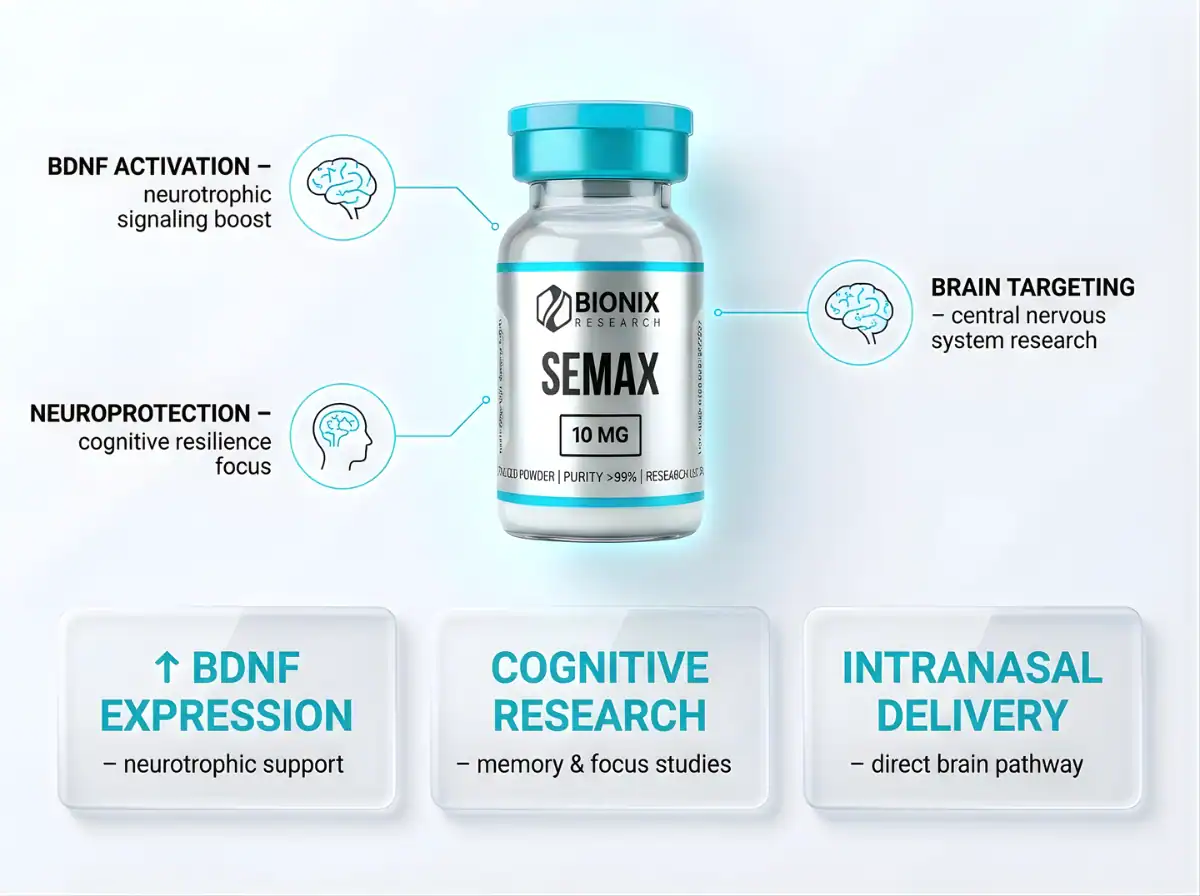
Semax Peptide: The Complete Science-Backed Guide to BDNF Activation [2026]
Key Takeaways: Semax at a Glance
| Aspect | Details |
|---|---|
| Classification | Synthetic heptapeptide (7 amino acids) |
| Sequence | Met-Glu-His-Phe-Pro-Gly-Pro |
| Primary Mechanism | BDNF/NGF upregulation, neurotransmitter modulation |
| Research Focus | Neuroprotection, cognitive function, stroke recovery |
| Administration | Intranasal (primary), subcutaneous (secondary) |
| Origin | Russian Academy of Sciences, 1980s |
Research Use Only:
Semax is classified as a research chemical in most Western countries. It is not approved for human consumption or disease treatment outside specific jurisdictions. All information presented serves educational purposes only.
The peptide revolution is happening now
Unlock the Advantage: Biological Optimization & Longevity Research Peptides
Semax
29,90 € Vialincl. VAT
plus Shipping Costs
Delivery time: 1–6 Working Days
What Makes Semax Different From Other Nootropics?
Most cognitive enhancers work like a volume knob—they amplify existing signals until the system burns out. Semax operates differently.
Instead of forcing neurotransmitter release, Semax activates your brain's own growth and repair systems. It triggers the production of BDNF (Brain-Derived Neurotrophic Factor), essentially fertilizing the neural soil so neurons can thrive, connect, and adapt.
The result? A compound that researchers study not for acute stimulation, but for long-term neuroplasticity support.
In this comprehensive guide, you'll discover:
- The exact molecular structure and origin of Semax
- How BDNF and NGF activation works at the cellular level
- 2025 research breakthroughs including Alzheimer's model studies
- Why intranasal delivery bypasses the blood-brain barrier
- Critical limitations and open scientific questions
What Is Semax? Molecular Identity Decoded
Semax is a heptapeptide—a chain of exactly seven amino acids arranged in this sequence:
Met-Glu-His-Phe-Pro-Gly-Pro
But here's what makes Semax fascinating: it's not a completely synthetic invention. It's an engineered fragment of something your body already produces.
The ACTH Connection
ACTH (Adrenocorticotropic Hormone) is a stress hormone produced in your pituitary gland. It normally triggers cortisol release from your adrenal glands—part of your fight-or-flight response.
Soviet scientists in the 1980s extracted amino acids 4-7 from ACTH and added a stabilizing tripeptide tail (Pro-Gly-Pro). This modification achieved something remarkable:
| Property | Original ACTH | Modified Semax |
|---|---|---|
| Hormonal activity | High | None |
| Neurotropic activity | Low | High |
| Metabolic stability | Minutes | Hours |
| Blood-brain barrier penetration | Limited | Enhanced |
Think of it this way: Scientists took a stress hormone, removed its stressful properties, and kept only the brain-supporting effects.
Development History
Semax emerged from the Institute of Molecular Genetics at the Russian Academy of Sciences during the 1980s. The original goal: develop a neuroprotective agent for ischemic stroke patients.
Today, Semax holds approved medical status in Russia for stroke treatment and cognitive disorders, while remaining classified as a research chemical throughout Europe and North America.
How Does Semax Work? Four Mechanisms Explained
Semax doesn't hit a single target. It orchestrates multiple neurobiological systems simultaneously.
1. BDNF Upregulation: Fertilizer for Neurons
BDNF (Brain-Derived Neurotrophic Factor) is arguably the most important protein for brain health. It:
- Supports neuron survival under stress
- Promotes synapse formation (how neurons connect)
- Enables neuroplasticity (how the brain adapts and learns)
What Semax does: Increases BDNF mRNA expression in the hippocampus—the brain's memory center—through CREB-dependent transcription pathways.
Simple translation: Semax tells your neurons to produce more of their own survival and growth signals.
2. NGF Enhancement: The Support Network
NGF (Nerve Growth Factor) complements BDNF by supporting sensory neurons and the cholinergic system (crucial for memory and attention).
If BDNF is the fertilizer, NGF is the irrigation system. Both must function optimally for neural health.
3. Neurotransmitter Modulation
Semax influences the synthesis of:
| Neurotransmitter | Function | Semax Effect |
|---|---|---|
| Dopamine | Motivation, focus, reward | Enhanced synthesis |
| Serotonin | Mood, impulse control | Increased turnover |
| Acetylcholine | Learning, memory | Improved circulation |
Importantly, Semax activates these pathways most strongly under stress conditions—when the brain needs support most.
4. Enkephalinase Inhibition
Semax slows the breakdown of endorphins (your body's natural painkillers and mood regulators). This extends the duration of your body's own "feel-good" molecules without artificial stimulation.
Mechanism Summary Table
| Target System | Molecular Action | Functional Outcome |
|---|---|---|
| BDNF/TrkB pathway | ↑ BDNF mRNA via CREB | Enhanced neuron survival & plasticity |
| NGF expression | ↑ NGF production | Sensory neuron support |
| Dopaminergic system | Gene activation | Improved focus & motivation |
| Serotonergic system | Enhanced turnover | Mood stabilization |
| Enkephalinase | Enzyme inhibition | Prolonged endorphin activity |
Latest Research: What 2024-2025 Studies Reveal
Alzheimer's Disease Models (2025)
A December 2025 study published in Acta Naturae demonstrated significant findings in APP/PS1 transgenic mice (a standard Alzheimer's model):
- 30-day intranasal Semax administration improved performance in:
- Open field tests (anxiety/exploration)
- Novel object recognition (memory)
- Barnes maze (spatial learning)
- Amyloid plaque reduction observed in cortex and hippocampus
- A heptapeptide derivative showed comparable benefits
Significance: This represents the first robust preclinical evidence for Semax in Alzheimer's-related pathology, opening potential therapeutic development pathways.
Spinal Cord Injury Recovery (2025)
Research published in the British Journal of Pharmacology (July 2025) identified a novel mechanism: Semax targets the μ-opioid receptor gene (Oprm1) to promote deubiquitination and functional recovery after spinal cord injury in female rodent models.
Ischemic Stroke (Ongoing)
Transcriptomic analysis continues to confirm Semax's neuroprotective effects through:
- Neurotrophin gene upregulation
- Inflammatory pathway suppression
- Neurotransmission system modulation
Evidence Quality Assessment
| Research Area | Evidence Level | Key Findings |
|---|---|---|
| Ischemic stroke | Clinical (Russia) | Accelerated neurological recovery |
| Cognitive function | Preclinical | Memory consolidation improvement |
| Alzheimer's models | Preclinical (2025) | Plaque reduction, cognitive improvement |
| Spinal injury | Preclinical (2025) | Functional recovery via Oprm1 |
| ADHD | Preliminary | Dopamine/serotonin modulation hypothesis |
Administration: Why Intranasal Delivery Dominates
The Peptide Stability Problem
Peptides are fragile molecules. Oral administration would result in:
- Rapid degradation by stomach acid
- Enzymatic breakdown in the intestinal tract
- Minimal absorption into the bloodstream
Bioavailability of oral peptides: typically < 2%
The Nasal Advantage
The nasal mucosa offers a unique pathway:
- Rich blood supply enables rapid absorption
- Olfactory nerve proximity provides direct CNS access
- Partial blood-brain barrier bypass through the cribriform plate
- Non-invasive compared to injection
| Administration Route | Advantages | Limitations |
|---|---|---|
| Intranasal | Direct CNS access, non-invasive, fast onset | Dose precision varies, technique-dependent |
| Subcutaneous | Precise dosing, consistent absorption | Invasive, less direct brain delivery |
Dosage Parameters in Research
Human clinical data (primarily Russian studies):
- Intranasal: 1.2mg starting dose, up to 1mg/kg body weight
- Duration: Protocols vary from acute (single dose) to chronic (30+ days)
Note: No standardized Western protocol exists. Research dosages should not be interpreted as recommendations.
Critical Limitations: What We Don't Know
Geographic Research Gap
The majority of Semax research originates from Russia, where it holds medical approval. Key limitations:
- No large-scale Western RCTs (randomized controlled trials)
- Publication accessibility issues (language barriers, journal indexing)
- Replication deficit in European/American institutions
Unanswered Scientific Questions
| Question | Current Status |
|---|---|
| Long-term safety profile | Unknown beyond Russian clinical use |
| Tolerance development | Not systematically studied |
| Genetic response variability | Individual differences unexplored |
| Optimal dosing protocols | No standardized Western guidelines |
| Drug interactions | Minimal data available |
Regulatory Reality
| Region | Status |
|---|---|
| Russia | Approved medication (stroke, cognitive disorders) |
| European Union | Research chemical (not approved for human use) |
| United States | Research chemical (not approved for human use) |
| United Kingdom | Research chemical (not approved for human use) |
Semax vs. Other Nootropics: Positioning
| Compound | Mechanism | Onset | Duration | Research Depth |
|---|---|---|---|---|
| Semax | Neurotrophic modulation | Gradual | Long-term | Moderate (Russia-focused) |
| Racetams | Acetylcholine modulation | Rapid | Short-term | Extensive |
| Modafinil | Dopamine reuptake | Rapid | Medium-term | Extensive |
| Noopept | Glutamate/BDNF | Rapid | Short-term | Moderate |
Key differentiator: Semax works upstream—enhancing the brain's capacity for growth and adaptation rather than directly stimulating activity.
The peptide revolution is happening now
Unlock the Advantage: Biological Optimization & Longevity Research Peptides
Semax
29,90 € Vialincl. VAT
plus Shipping Costs
Delivery time: 1–6 Working Days
Frequently Asked Questions
Is Semax a hormone?
No. Although derived from the hormone ACTH, Semax has been structurally modified to eliminate hormonal activity. It does not affect cortisol levels or the HPA axis.
How does Semax compare to Selank?
Both are Russian-developed neuropeptides, but with different targets:
- Semax: BDNF/NGF upregulation, dopamine modulation
- Selank: GABA modulation, anxiolytic properties, immune function
They are sometimes researched in combination.
Can Semax be taken orally?
Not effectively. Gastric acid and digestive enzymes would degrade the peptide before absorption. Intranasal administration is the standard research protocol.
What is N-Acetyl Semax Amidate?
A modified version of Semax with:
- N-acetyl group: Enhanced stability
- Amide group: Improved lipophilicity and membrane penetration
Some researchers report increased potency, though comparative studies are limited.
Are there contraindications in research contexts?
Limited data exists. Theoretical concerns include:
- Concurrent use with other dopaminergic compounds
- Individuals with hypersensitivity to peptides
- Pregnancy/lactation (no safety data)
Glossary of Key Terms
| Term | Definition |
|---|---|
| Heptapeptide | A chain of seven amino acids |
| BDNF | Brain-Derived Neurotrophic Factor—protein supporting neuron survival and growth |
| NGF | Nerve Growth Factor—protein supporting sensory and cholinergic neurons |
| ACTH | Adrenocorticotropic Hormone—stress hormone from which Semax was derived |
| Neuroplasticity | The brain's ability to reorganize by forming new neural connections |
| Neuroprotection | Mechanisms that protect neurons from damage or death |
| TrkB | Receptor for BDNF that initiates survival and plasticity cascades |
| Intranasal | Administration through the nasal mucosa |
References
Gusev EI et al. (2005). "The efficacy of semax in the treatment of patients with ischemic stroke." Zh Nevrol Psikhiatr Im S S Korsakova, 105(6):16-20. PMID: 11550362
Medvedeva EV et al. (2014). "The peptide semax affects the expression of genes related to the immune and vascular systems in rat brain focal ischemia." Mol Biol (Mosk), 48(3):520-529. PMID: 25842266
Acta Naturae (2025). "The Potential of the Peptide Drug Semax and Its Derivative for Alzheimer's Disease." DOI: Pending
British Journal of Pharmacology (2025). "Semax peptide targets the μ opioid receptor gene Oprm1 to promote deubiquitination and functional recovery after spinal cord injury." DOI: 10.1111/bph.70122
Innerbody Research (2026). Semax Peptide Review. Retrieved from innerbody.com/semax-peptide
Research Use Only Disclaimer: The information presented serves exclusively educational purposes. Semax is not approved as a medication in most Western countries and is sold as a research chemical (Research Use Only). It is not intended for human consumption or disease treatment.
No Guarantee Disclaimer: Information provided reflects the state of research at publication time. Scientific understanding evolves continuously; no guarantee of accuracy, completeness, or currentness can be made. Use of this information is at the reader's own risk.

