


Knowledge Base
What is Tesamorelin? The Only FDA-Approved Peptide for Targeted Abdominal Fat Loss

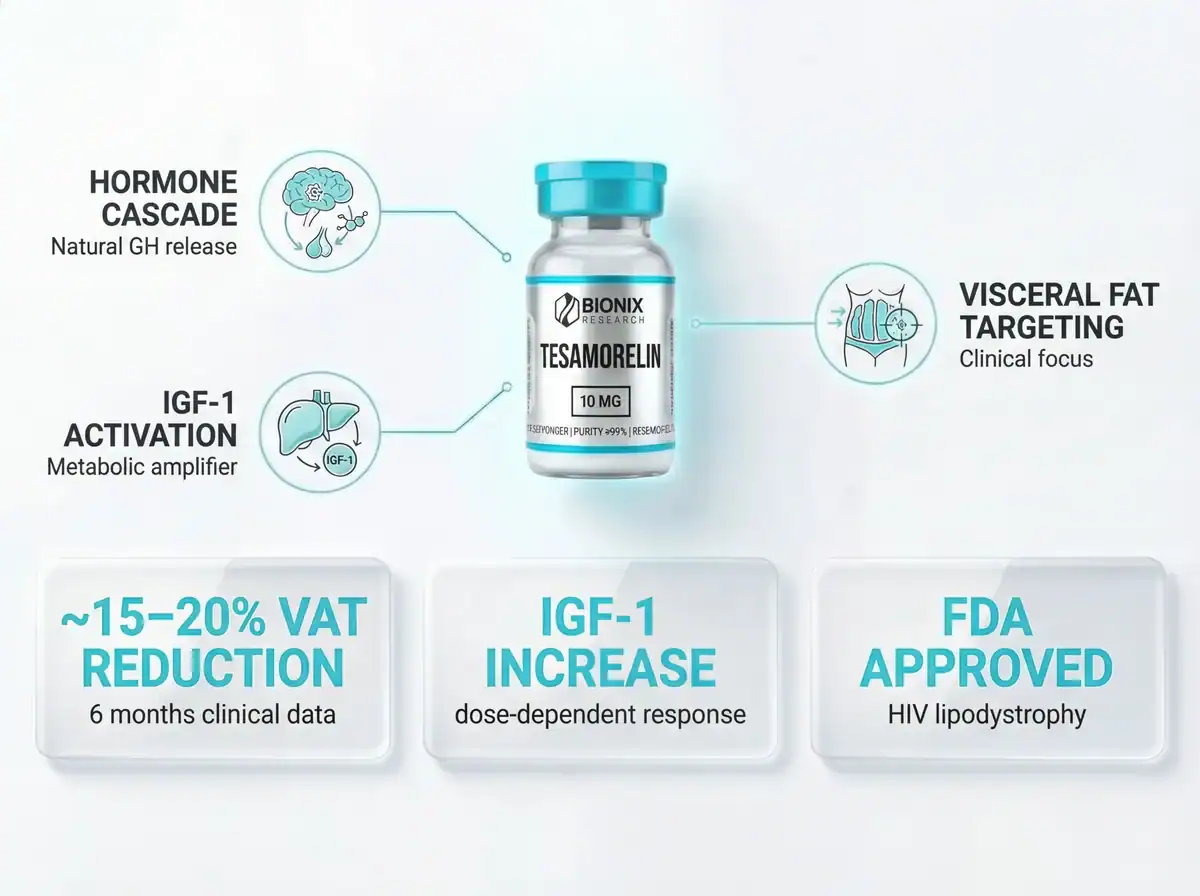
Tesamorelin Peptide: The FDA-Approved GHRH Analog for Visceral Fat Reduction [2026]
Key Takeaways: Tesamorelin at a Glance
| Property | Details |
|---|---|
| Classification | Synthetic GHRH analog (44 amino acids) |
| Primary Mechanism | Pituitary GH release → IGF-1 elevation → selective lipolysis |
| FDA-Approved Indication | HIV-associated lipodystrophy (excess visceral fat) |
| Clinical Efficacy | ~15% visceral fat reduction in 26 weeks (Phase 3 trials) |
| Administration | Daily subcutaneous injection (2mg) |
| Brand Name | Egrifta® |
Research Use Only:
Tesamorelin (Egrifta®) is an FDA-approved prescription medication requiring physician supervision. The research-grade substance discussed here is for laboratory research only (RUO) and is not intended for human use. All information serves educational purposes only.
The peptide revolution is happening now
Unlock the Advantage: Biological Optimization & Longevity Research Peptides
Tesamorelin
79,90 € Vialincl. VAT
plus Shipping Costs
Delivery time: 1–6 Working Days
The Precision Approach to Visceral Fat
Most fat-loss strategies treat all adipose tissue equally. Tesamorelin doesn't.
This 44-amino acid peptide specifically targets visceral adipose tissue (VAT)—the metabolically dangerous fat surrounding your organs—while preserving subcutaneous fat and lean muscle mass. It's the only FDA-approved medication specifically designed to address this distinction.
The mechanism: Rather than directly burning fat, Tesamorelin activates your body's natural growth hormone axis, triggering a hormonal cascade that selectively mobilizes abdominal fat stores.
In this comprehensive guide, you'll discover:
- The molecular architecture that extends Tesamorelin's half-life
- The complete signaling pathway from receptor binding to fat mobilization
- 2024-2025 research breakthroughs in NAFLD, cognition, and muscle function
- Evidence quality across different research applications
- How Tesamorelin compares to other GHRH analogs
What Is Tesamorelin? Molecular Identity
A Modified GHRH Analog
Tesamorelin is a synthetic 44-amino acid peptide that replicates the action of your body's natural Growth Hormone-Releasing Hormone (GHRH), with one critical modification.
Natural GHRH: Released by the hypothalamus, signals the pituitary to produce growth hormone. Half-life: approximately 7-10 minutes.
Tesamorelin: Identical amino acid sequence to GHRH(1-44), plus a trans-3-hexenoic acid modification at the N-terminus.
The Trans-3-Hexenoic Acid Shield
This chemical modification serves a crucial function: protection from enzymatic degradation.
| Property | Natural GHRH | Tesamorelin |
|---|---|---|
| Amino acids | 44 | 44 |
| N-terminus modification | None | Trans-3-hexenoic acid |
| Plasma half-life | ~7-10 minutes | ~26-38 minutes |
| Stability | Rapidly degraded | 5-10x more stable |
Simple analogy: If natural GHRH is a message written on water, Tesamorelin is the same message carved in stone—it lasts long enough to deliver its signal effectively.
The Hormonal Cascade
Tesamorelin operates through a four-step hormonal relay:
Tesamorelin → Pituitary (GH release) → Liver (IGF-1 production) → Fat tissue (lipolysis)
Step-by-step:
- Hypothalamus replacement: Tesamorelin substitutes for natural GHRH
- Pituitary activation: GHRH receptors stimulated → pulsatile GH release
- Liver response: GH triggers IGF-1 synthesis
- Tissue effects: IGF-1 activates fat mobilization, particularly in visceral depots
How Does Tesamorelin Work? Mechanism Explained
Step 1: GHRH Receptor Binding
Tesamorelin binds to GHRH receptors on somatotropic cells in the anterior pituitary gland. These G-protein coupled receptors initiate an intracellular signaling cascade.
Signaling pathway:
- Receptor activation → G-protein stimulation
- Adenylyl cyclase activation → cAMP increase
- PKA (Protein Kinase A) activation
- Gene transcription for GH synthesis
- Pulsatile GH release (mimics natural rhythm)
The pulsatile pattern is critical—continuous GH elevation has different (and less beneficial) effects than the natural episodic release Tesamorelin stimulates.
Step 2: Growth Hormone Release
Within hours of administration, measurable increases in circulating growth hormone occur. This GH elevation is:
- Dose-dependent: Higher doses produce greater GH peaks
- Pulsatile: Maintains physiological release pattern
- Transient: Returns to baseline, preventing receptor desensitization
Step 3: IGF-1 Production
Circulating GH reaches the liver and binds to hepatic GH receptors, stimulating IGF-1 (Insulin-like Growth Factor-1) synthesis.
IGF-1 serves as the primary effector for many of Tesamorelin's metabolic effects:
- Longer half-life than GH (~15-20 hours vs. minutes)
- More stable indicator of GH axis activation
- Direct action on target tissues
Clinical measurement: IGF-1 levels are used to monitor Tesamorelin efficacy and safety.
Step 4: Selective Lipolysis
IGF-1 activates lipolytic pathways, but with notable selectivity:
| Fat Depot | Response to Tesamorelin |
|---|---|
| Visceral adipose tissue (VAT) | High sensitivity → significant reduction |
| Subcutaneous adipose tissue (SAT) | Lower sensitivity → preserved |
| Intrahepatic fat | Responsive → reduced (emerging data) |
Why the selectivity? Visceral adipocytes have higher receptor density and sensitivity to lipolytic signals compared to subcutaneous fat cells.
Mechanism Summary Table
| Step | Location | Molecular Event | Timeframe |
|---|---|---|---|
| 1. Receptor binding | Pituitary | GHRH-R activation → cAMP/PKA cascade | Minutes |
| 2. GH release | Pituitary → Blood | Pulsatile GH secretion | Hours |
| 3. IGF-1 synthesis | Liver | GH-R activation → IGF-1 production | Days |
| 4. Fat mobilization | Adipose tissue | IGF-1 signaling → lipolysis | Weeks-Months |
Clinical Evidence: FDA-Approved Indication
HIV-Associated Lipodystrophy
Tesamorelin received FDA approval in 2010 specifically for treating excess abdominal fat in HIV-infected patients with lipodystrophy—a condition caused by antiretroviral therapy (ART) that results in abnormal fat distribution.
Phase 3 Trial Data
Pooled analysis of Phase 3 randomized controlled trials (n=806):
| Outcome | Tesamorelin | Placebo | P-value |
|---|---|---|---|
| VAT reduction (26 weeks) | -15.4% | -0.6% | <0.001 |
| VAT reduction (52 weeks, continued) | Maintained | Reversed | - |
| IGF-1 increase | Significant | No change | <0.001 |
| Triglyceride improvement | Yes | No | <0.05 |
Key findings:
- 15% visceral fat reduction within 26 weeks
- Effects maintained with continued treatment up to 52 weeks
- Reversal upon discontinuation: VAT returns toward baseline when treatment stops
- Subcutaneous fat and lean body mass preserved
Long-Term Safety (104 weeks)
Extended follow-up demonstrated:
- Sustained efficacy with continued treatment
- No increased cancer risk observed
- Stable glucose parameters in most patients
- Acceptable tolerability profile
Latest Research: 2024-2025 Updates
NAFLD and Liver Fat Reduction
Emerging data suggests Tesamorelin significantly reduces hepatic fat content in HIV patients with non-alcoholic fatty liver disease (NAFLD):
- ~37% reduction in liver fat in randomized trials
- Decreased markers of inflammation and fibrosis
- Potential application beyond HIV populations under investigation
Significance: NAFLD affects approximately 25% of the global adult population, making this a potentially impactful research direction.
Cognitive Function Research (2025)
A study published in June 2025 examined Tesamorelin's effects on neurocognitive impairment (NCI) in HIV patients:
- Mechanism hypothesis: IGF-1 elevation may reduce oxidative stress and support neuronal health
- Abdominal obesity (AO) link: VAT reduction correlates with improved cognitive markers
- Ongoing trials investigating direct cognitive endpoints
Physical Function and Muscle Health (Ongoing Trial)
NCT06554717 (initiated August 2024): A 24-week randomized controlled trial examining Tesamorelin as an exercise adjunct:
Study design:
- Tesamorelin + home exercise vs. placebo + home exercise
- Population: Adults with HIV
- Primary endpoints: Muscle mass and quality (CT measurement), physical performance
- Secondary endpoints: VAT reduction, exercise adherence, quality of life
- 24-week extension phase assessing effect persistence after cessation
Significance: This trial tests whether Tesamorelin can enhance exercise-induced improvements in body composition and function.
Additional Ongoing Research
NCT03375788: 12-month double-blind RCT + 6-month open-label extension
- Tesamorelin 2mg SC daily vs. placebo
- Population: HIV patients with abdominal obesity
- Focus: Comprehensive metabolic outcomes
Evidence Evolution Summary
| Research Area | Status (2026) | Key Findings |
|---|---|---|
| HIV lipodystrophy | FDA-approved | 15% VAT reduction, maintained to 52 weeks |
| NAFLD (HIV population) | Phase 2/3 | 37% liver fat reduction |
| Cognitive function | Emerging | IGF-1 elevation may improve NCI markers |
| Muscle/physical function | Ongoing trial | Exercise adjunct hypothesis |
| Non-HIV metabolic obesity | Investigational | Limited data; not approved |
Tesamorelin vs. Other GHRH Analogs
Comparison Table
| Peptide | Structure | Half-life | FDA Status | Primary Research Focus |
|---|---|---|---|---|
| Tesamorelin | GHRH(1-44) + trans-3-hexenoic acid | ~30 min | Approved (HIV lipodystrophy) | Visceral fat, NAFLD |
| Sermorelin | GHRH(1-29) | ~10-20 min | Discontinued (US) | GH deficiency diagnosis |
| CJC-1295 | GHRH(1-29) + DAC | Days (with DAC) | Not approved | Research only |
| Modified GRF(1-29) | GHRH(1-29) + modifications | ~30 min | Not approved | Research only |
Key Differentiators
Tesamorelin advantages:
- Only FDA-approved GHRH analog for a specific indication
- Full 44-amino acid sequence (closest to natural GHRH)
- Extensive Phase 3 clinical trial data
- Established safety profile over 104 weeks
Tesamorelin limitations:
- Daily injection requirement
- Effects reverse upon discontinuation
- Approved only for HIV lipodystrophy (off-label use not covered)
- Higher cost than research-grade alternatives
Safety Profile and Considerations
Commonly Reported Effects
| Effect | Incidence | Notes |
|---|---|---|
| Injection site reactions | ~30% | Erythema, pruritus, pain |
| Arthralgia (joint pain) | ~13% | Usually mild-moderate |
| Peripheral edema | ~6% | Fluid retention |
| Myalgia (muscle pain) | ~5% | Usually transient |
| Paresthesia | ~5% | Numbness/tingling |
Metabolic Monitoring Requirements
Glucose parameters:
- Tesamorelin can affect fasting glucose and HbA1c
- Regular monitoring required, especially in patients with diabetes risk
- Most studies show no significant glucose deterioration in HIV populations
IGF-1 levels:
- Should be maintained within age-appropriate normal range
- Excessive elevation may require dose adjustment
- Monitoring recommended at baseline and periodically during treatment
Theoretical Concerns
| Concern | Rationale | Current Evidence |
|---|---|---|
| Cancer risk | GH/IGF-1 may theoretically promote tumor growth | No increased risk in trials up to 104 weeks; age-appropriate screening recommended |
| Glucose dysregulation | GH can antagonize insulin action | Monitor glucose; most patients stable |
| Pituitary effects | Long-term receptor stimulation | No pituitary tumors reported |
Contraindications and Precautions
Per FDA labeling:
- Active malignancy
- Hypersensitivity to tesamorelin or mannitol
- Pregnancy (Category X)
- Disruption of the hypothalamic-pituitary axis
Practical Considerations
Treatment Protocols
Approved regimen:
- 2mg subcutaneous injection daily
- Injection site rotation (abdomen)
- Typically continued as long as benefit is maintained
Observed timelines:
- IGF-1 elevation: Days
- Measurable VAT reduction: 12-16 weeks
- Maximum effects: ~26 weeks
- Reversal after discontinuation: Weeks to months
What Happens When You Stop?
Clinical data clearly shows that effects are not permanent:
- VAT begins to reaccumulate upon discontinuation
- IGF-1 returns to baseline
- This necessitates long-term treatment for sustained benefit
Cost and Access Considerations
- Prescription required: Not available without physician supervision
- Insurance: Generally covered only for approved indication (HIV lipodystrophy)
- Off-label use: Typically not covered; out-of-pocket costs significant
Open Scientific Questions
| Question | Current Status |
|---|---|
| Long-term cardiovascular outcomes? | Metabolic improvements observed, but hard endpoint trials lacking |
| Efficacy in non-HIV populations? | Limited data; not approved for general obesity |
| Optimal treatment duration and cycling? | No consensus; often 3-4 months on, 1 month off (clinical practice) |
| Combination with other interventions? | Exercise combination trial ongoing (NCT06554717) |
| Cognitive benefits confirmation? | Promising signals; dedicated trials needed |
Summary
Tesamorelin is a structurally modified GHRH analog that stimulates pulsatile growth hormone release, leading to IGF-1 elevation and selective visceral fat mobilization. As the only FDA-approved medication for HIV-associated lipodystrophy, it demonstrates:
- 15% visceral fat reduction within 26 weeks (Phase 3 data)
- Preserved lean mass and subcutaneous fat
- Improved lipid profiles (triglycerides)
- Acceptable safety over 104 weeks
2024-2025 research expands the evidence base into NAFLD (37% liver fat reduction), cognitive function, and physical performance enhancement as an exercise adjunct. Key limitations include the requirement for daily injections, effect reversal upon discontinuation, and the narrow approved indication.
For researchers studying the GH/IGF-1 axis, metabolic regulation, or body composition, Tesamorelin represents a well-characterized tool with extensive clinical validation.
The peptide revolution is happening now
Unlock the Advantage: Biological Optimization & Longevity Research Peptides
Tesamorelin
79,90 € Vialincl. VAT
plus Shipping Costs
Delivery time: 1–6 Working Days
Frequently Asked Questions
What is Tesamorelin?
Tesamorelin is a synthetic 44-amino acid peptide analog of natural GHRH (Growth Hormone-Releasing Hormone). It stimulates the pituitary gland to release growth hormone in a pulsatile pattern, which subsequently increases IGF-1 levels and promotes visceral fat mobilization.
How does Tesamorelin differ from direct GH injection?
Tesamorelin stimulates your body's own GH production, maintaining the natural pulsatile release pattern. Direct GH injection bypasses this regulation, potentially causing different effects and side effect profiles. Tesamorelin also allows the pituitary's feedback mechanisms to remain functional.
What is the FDA-approved indication?
Tesamorelin (Egrifta®) is approved specifically for the reduction of excess abdominal fat in HIV-infected patients with lipodystrophy. Off-label use for other indications is not FDA-approved.
How quickly does Tesamorelin work?
IGF-1 increases are measurable within days. Visible changes in body composition typically appear after 12-16 weeks, with maximum effects observed around 26 weeks of treatment.
Do the effects last after stopping treatment?
No. Clinical data shows that visceral fat begins to reaccumulate after discontinuation. Continued treatment is required to maintain benefits.
Does Tesamorelin affect blood sugar?
Tesamorelin can influence glucose parameters. Regular monitoring of fasting glucose and HbA1c is recommended during treatment. Most studies in HIV populations showed no significant deterioration.
How does Tesamorelin compare to Sermorelin or CJC-1295?
Tesamorelin is the only FDA-approved GHRH analog with extensive Phase 3 clinical trial data. Sermorelin (GHRH 1-29) has a shorter half-life and was discontinued in the US. CJC-1295 is a research compound without FDA approval.
What are the main side effects?
The most common side effects include injection site reactions (~30%), joint pain, fluid retention, and muscle aches. Most are mild to moderate. Regular monitoring is required.
Glossary
| Term | Definition |
|---|---|
| GHRH | Growth Hormone-Releasing Hormone—hypothalamic peptide that stimulates pituitary GH release |
| GH | Growth Hormone—pituitary hormone regulating growth, metabolism, and body composition |
| IGF-1 | Insulin-like Growth Factor-1—liver-produced hormone mediating many GH effects |
| VAT | Visceral Adipose Tissue—fat surrounding internal organs; metabolically active |
| SAT | Subcutaneous Adipose Tissue—fat beneath the skin; less metabolically active |
| Lipodystrophy | Abnormal fat distribution, often drug-induced |
| Lipolysis | Breakdown of fat for energy |
| cAMP | Cyclic adenosine monophosphate—intracellular signaling molecule |
| PKA | Protein Kinase A—enzyme activated by cAMP in signaling cascades |
| NAFLD | Non-Alcoholic Fatty Liver Disease—liver fat accumulation without alcohol cause |
| Pulsatile release | Episodic hormone secretion pattern mimicking natural physiology |
References
Falutz J, et al. (2010). "Effects of tesamorelin on visceral fat accumulation in HIV lipodystrophy." J Clin Endocrinol Metab. 95(2):570-7. PMID: 20177240
Falutz J, et al. (2007). "Effects of tesamorelin, a growth hormone-releasing factor analog, in HIV-infected patients with abdominal fat accumulation." J Acquir Immune Defic Syndr. 46(3):245-53. PMID: 17652298
Stanley TL, et al. (2015). "Effects of tesamorelin on inflammatory markers in HIV patients with excess abdominal fat." AIDS. 29(10):1181-90. PMID: 25611733
Makimura H, et al. (2010). "Effects of Tesamorelin (TH9507), a Growth Hormone-Releasing Factor Analog, in HIV-Infected Patients." J Clin Endocrinol Metab. 95(9):4291-8.
ClinicalTrials.gov (2024). "Tesamorelin as an Adjunct to Exercise for Improving Physical Function." NCT06554717
Oregon DURM (2025). "Prior Authorization Update: Tesamorelin (EGRIFTA)." Accessed January 2026.
eScholarship (2025). "Effects of Tesamorelin on Neurocognitive Impairment in Persons with HIV."
Research Use Only Disclaimer: The research-grade substance discussed in this article is intended exclusively for laboratory research purposes and is not approved for human consumption, medical applications, or for diagnosis, treatment, or prevention of disease. Tesamorelin (Egrifta®) as a prescription medication requires physician supervision.
No Guarantee Disclaimer: Information provided reflects the state of research at publication time. Scientific understanding evolves continuously; no guarantee of accuracy, completeness, or currentness can be made.

