Fundamentals, Longevity, Peptide Research

What Are Peptides? The Fundamental Building Blocks of Biology

Table of Contents show

What Are Peptides? The Molecular Messengers Driving Modern Research

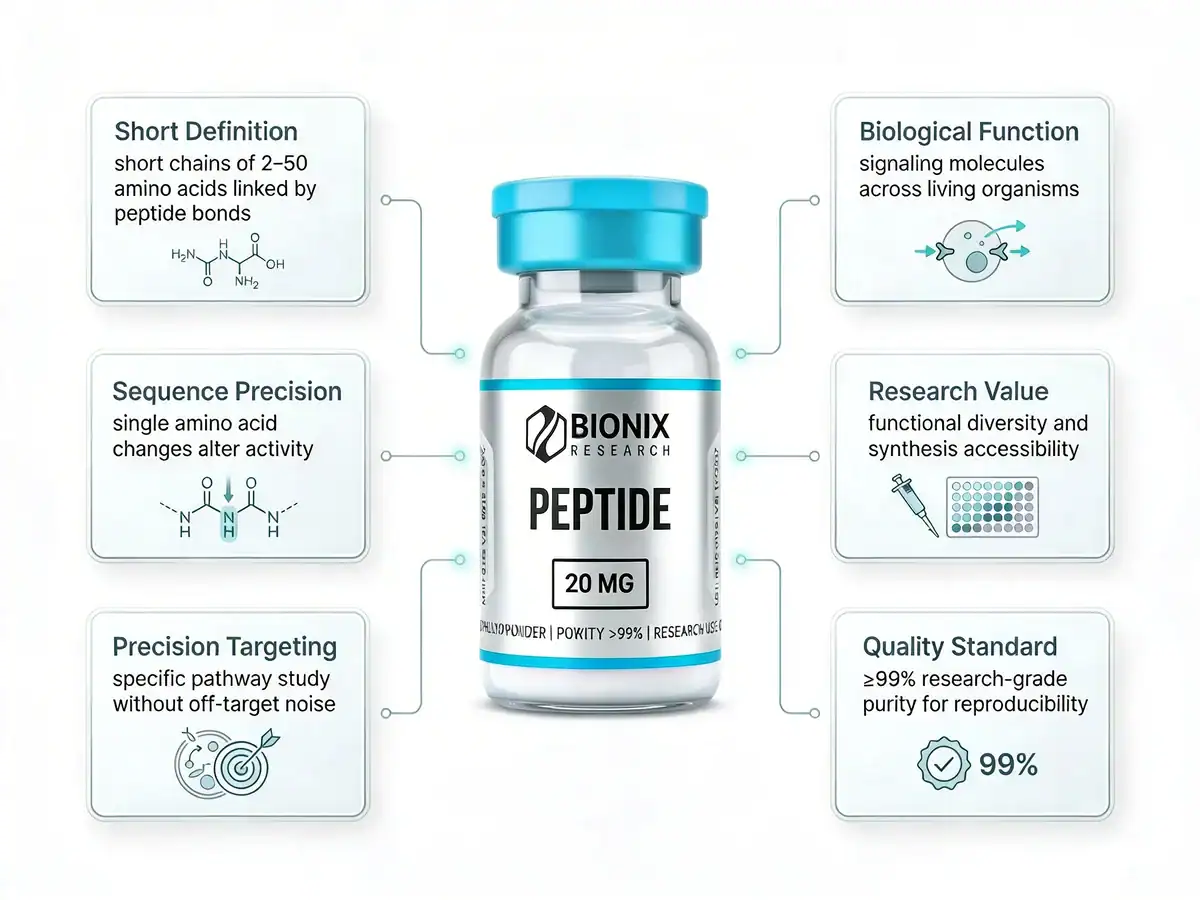
Key Takeaways at a Glance

Before diving deep, here's what you'll learn about peptides:

  • Definition: Peptides are short chains of 2-50 amino acids linked by peptide bonds
  • Function: They act as biological signaling molecules throughout every living organism
  • Sequence Matters: Even single amino acid changes can dramatically alter biological activity
  • Research Value: Combine synthesis accessibility with remarkable functional diversity
  • Precision Targeting: Enable researchers to study specific pathways without off-target interference
  • Quality Standard: Research-grade purity of ≥99% is essential for reproducible data
For selected members only

Access to the world's most coveted premium peptides for biological optimization and longevity

Understanding Peptides: Nature's Molecular Language

Every living organism communicates through chemistry. At the heart of this molecular conversation lies a class of compounds that scientists have spent decades learning to understand and synthesize: peptides.

Peptides are short chains of amino acids linked together by chemical bonds. They represent one of nature's most elegant solutions to biological coordination. Where hormones broadcast messages across entire organ systems and neurotransmitters flash signals across synaptic gaps, peptides work with surgical precision—targeting specific receptors to trigger carefully calibrated responses.

The word "peptide" derives from the Greek "peptós," meaning digested or digestible. This etymology hints at their discovery through protein breakdown studies. But modern science reveals peptides as far more than digestive byproducts. They orchestrate processes ranging from immune defense to tissue repair, from metabolic regulation to cellular communication.

The Amino Acid Alphabet

To grasp what makes peptides special, imagine the 20 naturally occurring amino acids as letters in an alphabet. Just as letters combine to form words with distinct meanings, amino acids link together to create peptides with specific biological functions.

Consider these parallels:

  • A three-letter word differs fundamentally from a ten-letter word
  • Similarly, a tripeptide behaves differently from a decapeptide
  • Change one letter, and the meaning shifts entirely
  • Substitute one amino acid, and the peptide's biological activity transforms

This sequence-dependent functionality distinguishes peptides from many other biological molecules. It also explains why researchers find them so fascinating—and so useful.


The Chemistry Behind Peptide Formation

Understanding peptides requires understanding how they form. The process begins with individual amino acids, each containing two reactive groups: an amino group (-NH₂) and a carboxyl group (-COOH). When two amino acids meet under the right conditions, something remarkable happens.

The carboxyl group of one amino acid reacts with the amino group of another. This condensation reaction expels a single water molecule and forges a covalent bond between the two amino acids. Chemists call this the peptide bond—a sturdy amide linkage that forms the backbone of every peptide and protein in existence.

Key Characteristics of Peptide Bonds

PropertyDescriptionWhy It Matters
Planar GeometryAtoms arrange in a flat planeCreates predictable backbone structure
Trans ConfigurationMost bonds adopt trans arrangementContributes to structural rigidity
Covalent NatureStrong chemical bondEnsures stability under physiological conditions
DirectionalityCreates N-terminus and C-terminusEstablishes consistent sequence notation

Each time another amino acid joins the chain, another peptide bond forms, another water molecule departs, and the peptide grows longer. The chain develops two distinct ends:

  • N-terminus: Free amino group (written on the left)
  • C-terminus: Free carboxyl group (written on the right)

The Mathematics of Molecular Diversity

Consider the combinatorial implications of peptide chemistry:

Peptide LengthPossible SequencesExample
Dipeptide (2 AA)40020 × 20
Tripeptide (3 AA)8,00020³
Pentapeptide (5 AA)3.2 million20⁵
Decapeptide (10 AA)>10 trillion20¹⁰

This combinatorial explosion explains why nature has found peptides so useful—and why researchers find them so versatile.


From Sequence to Shape: How Structure Determines Function

The relationship between peptide sequence and peptide function represents one of biochemistry's central principles. Every biological effect a peptide produces traces back to its structure, and that structure emerges from its sequence.

The Four Levels of Peptide Structure

Scientists describe peptide structure using a hierarchical system:

1. Primary Structure The amino acid sequence itself—which amino acids appear in which order. This linear arrangement constitutes the most fundamental level of structural information.

2. Secondary Structure Local folding patterns that emerge from hydrogen bonding along the peptide backbone:

  • Alpha helices spiral like corkscrews
  • Beta sheets align backbone segments side by side

3. Tertiary Structure The overall three-dimensional shape of the folded peptide, driven by:

  • Hydrophobic clustering (away from water)
  • Electrostatic attractions between charged side chains
  • Disulfide bridges between cysteine residues

4. Quaternary Structure (primarily in proteins) Multiple peptide chains associating together

Peptides vs. Proteins: A Critical Distinction

FeaturePeptidesProteins
Length2-50 amino acids>50 amino acids
Structural ComplexityPrimarily sequence-dependentRequires complex 3D folding
StabilityFunction across broader conditionsSensitive to misfolding
SynthesisEasier with high purityMore challenging
Structure-ActivityMore predictable relationshipsMultiple variables influence behavior

This difference carries profound practical implications. Small peptides remain functional across a broader range of conditions because they have less complex structure to disrupt. They're easier to synthesize, and they offer more predictable structure-activity relationships.


For selected members only

Access to the world's most coveted premium peptides for biological optimization and longevity

The Lock-and-Key Principle: Peptide-Receptor Interactions

Peptides exert their biological effects through interactions with receptors—specialized protein structures embedded in cell membranes or located within cells. Understanding these interactions illuminates why peptides achieve such precise biological targeting.

How Peptide-Receptor Binding Works

Receptors function as molecular locks. Each receptor recognizes and responds to specific molecular keys. For a peptide to activate a receptor, it must possess:

  • ✓ The correct amino acid sequence
  • ✓ The appropriate three-dimensional shape
  • ✓ The right distribution of chemical properties across its surface

When a peptide encounters its target receptor, complementary surfaces make contact through multiple interaction types:

Interaction TypeDescriptionRole in Binding
Hydrogen BondsSharing of H atoms between electronegative atomsPrimary recognition
Electrostatic AttractionsOpposite charges attractingSpecificity enhancement
Hydrophobic ContactsNon-polar regions clusteringBinding stability
Van der Waals ForcesWeak attractions between adjacent atomsFine-tuning affinity

Why Specificity Matters for Research

Successful binding triggers conformational changes in the receptor protein. These shape changes initiate intracellular signaling cascades—molecular chain reactions that ultimately produce biological effects:

  • Enzyme activation
  • Second messenger release
  • Ion channel opening
  • Changes in gene expression

The specificity of these interactions deserves emphasis. A peptide designed to bind cardiac receptors may show no meaningful interaction with gastric, pulmonary, or neural receptors. This selectivity enables coordinated physiological responses—and makes peptides invaluable research tools for studying specific biological pathways without confounding off-target effects.


The Rise of Small Peptide Research

Scientific attitudes toward peptides have undergone a remarkable transformation. Historical research operated under an assumption that biological activity required structural complexity. If a protein needed thousands of amino acids folded into intricate shapes to function, surely a small peptide couldn't accomplish much.

Contemporary research has thoroughly dispelled this notion.

Small peptides—typically defined as those containing fewer than 20 amino acids—have emerged as some of the most versatile and valuable tools in modern biological investigation.

Four Factors Driving the Peptide Research Revolution

1. Synthesis Accessibility Advances in solid-phase peptide synthesis have made small peptides remarkably accessible. Researchers can now obtain custom-synthesized peptides with specific sequences in quantities sufficient for extensive experimental programs. The cost and complexity barriers that once limited peptide research have largely fallen away.

2. Tractable Structure-Activity Relationships Because small peptides derive function primarily from sequence rather than complex folding, researchers can systematically modify individual amino acids and observe the effects. This approach has revealed:

  • Which residues are essential for function
  • Which can tolerate substitution
  • Which modifications might enhance desired properties

3. Broad Biological Activity Small peptides have demonstrated activities across an impressive range of domains—from metabolic regulation to immune modulation, from antimicrobial effects to tissue repair.

4. Technological Convergence AI-driven design platforms, advanced modification techniques, and interdisciplinary collaborations continue accelerating discovery.

The 2024-2025 Research Landscape

MetricData PointSignificance
AI Design PlatformsRFpeptides and similar toolsGenerate novel peptides optimized for specific targets
FDA Approvals2 peptide therapeutics (2024)Validates peptide research trajectory
Market Projection$106 billion by 2033Reflects growing research investment
Publication Growth15%+ annual increaseExpanding scientific interest

These figures reflect growing recognition that small peptides represent not a scientific curiosity but a major frontier in biological research.

For selected members only

Access to the world's most coveted premium peptides for biological optimization and longevity

Research Applications: Where Peptides Make a Difference

The versatility of peptides becomes apparent when surveying their research applications. Across multiple scientific domains, peptides serve as tools for understanding biological mechanisms that would otherwise remain opaque.

Six Key Research Domains

1. Metabolic Research Researchers have developed peptide analogs that selectively activate different components of insulin signaling pathways. By using these selective tools, scientists can dissect:

  • Which pathway branches contribute to glucose uptake
  • Which regulate lipid metabolism
  • Which influence other metabolic processes

Methodology: Glucose tolerance testing in animal models

2. Cellular Repair Mechanisms In-vitro wound healing assays—where researchers create scratches in cell monolayers and measure how quickly cells migrate to close the gap—have identified peptides that accelerate tissue regeneration.

Methodology: Scratch assay quantification

3. Immune Response Modulation Peptides can shift cytokine expression profiles, promoting inflammatory or anti-inflammatory responses depending on their sequence.

Methodology: ELISA-based cytokine quantification

4. Antimicrobial Research Many organisms produce antimicrobial peptides as part of their innate immune defenses. Researchers studying these natural compounds—and developing synthetic analogs—seek new approaches to combating bacterial resistance.

Methodology: Minimum inhibitory concentration (MIC) testing

5. Cardiovascular Research Isolated vessel preparations allow researchers to measure vasodilation responses to specific peptides, revealing how these molecules influence blood vessel tone.

Methodology: Vessel tension measurements

6. Neuroscience Applications Peptides that modulate neurotransmitter systems have illuminated mechanisms of synaptic plasticity—the ability of neural connections to strengthen or weaken based on activity.

Methodology: Electrophysiological recordings


Quality Matters: The Foundation of Reproducible Research

The value of any research finding depends on the quality of the materials used to generate it. In peptide research, this principle assumes particular importance because even small impurities can confound experimental results.

The Problem with Low-Purity Peptides

Consider what happens when a researcher uses a peptide preparation containing 90% target compound and 10% synthetic impurities:

  • Any observed biological effect might result from the intended peptide, from one of the impurities, or from some interaction between them
  • Reproducing the experiment becomes challenging because impurity profiles vary between batches
  • Drawing confident conclusions becomes nearly impossible

Analytical Methods for Quality Verification

MethodWhat It MeasuresStandard
HPLCPurity percentage≥99% for research grade
Mass SpectrometryMolecular identityConfirms intended sequence
Amino Acid AnalysisComposition verificationValidates synthesis accuracy
Endotoxin TestingContamination levels<1 EU/mg for cell studies

High-performance liquid chromatography (HPLC) provides the analytical foundation for peptide quality assessment. This technique separates peptide mixtures based on how different molecules interact with a stationary phase as solvent flows past. The resulting chromatogram reveals the primary compound peak alongside any impurity peaks.

Mass spectrometry complements HPLC by confirming molecular identity. Where HPLC indicates purity, mass spectrometry verifies that the primary compound actually possesses the intended molecular weight and amino acid composition.

Storage Best Practices

ConditionRecommendationRationale
Temperature-20°C or belowMinimizes degradation
LightProtected from lightPrevents photodegradation
MoistureDesiccated environmentPrevents hydrolysis
ReconstitutionAppropriate buffersMaintains stability
Freeze-ThawMinimize cyclesPreserves integrity

BIONIX Research: Excellence in Research Materials

BIONIX Research exists to provide researchers with peptide materials that meet the highest quality standards. We understand that reproducible science requires reproducible materials, and we have built our operations around this principle.

Our Quality Commitment

Every peptide in our catalog undergoes rigorous analytical verification:

  • ✓ HPLC analysis confirms ≥99% purity
  • ✓ Mass spectrometry validates molecular identity
  • ✓ Third-party testing provides independent documentation
  • ✓ Proper storage maintained throughout supply chain
  • ✓ Comprehensive documentation accompanies every order

Browse Our Extensive Catalog of Research Peptides

Important Considerations for Peptide Research

Intellectual honesty requires acknowledging the limitations that accompany current peptide knowledge. The findings discussed throughout this article derive primarily from preclinical models and in-vitro systems. Cell culture experiments, isolated tissue preparations, and animal studies have generated valuable insights, but these contexts differ from complex biological systems in important ways.

Variables Researchers Must Consider

FactorChallengeMitigation Strategy
Species DifferencesReceptor expression varies between organismsUse multiple model systems
Stability VariationPeptides degrade differently across conditionsTest in relevant matrices
Concentration EffectsComplex dose-response relationshipsPerform systematic titrations
Context DependenceIn-vitro ≠ in-vivo behaviorInclude appropriate controls

Best Experimental Practices

Negative Controls

  • Scrambled peptides (same amino acids, randomized order) help establish whether effects depend on specific sequence or merely peptide presence

Multiple Model Systems

  • Demonstrates consistency across different experimental contexts
  • Strengthens validity of research conclusions

Appropriate Scope

  • Laboratory observations do not automatically translate to other contexts
  • Mechanistic understanding of many peptide-receptor interactions remains incomplete

Important Disclaimer: All peptides discussed herein are intended for laboratory research only. They are not approved for human use, and the information provided does not constitute medical advice or therapeutic recommendations.


The Future Belongs to Peptides

What are peptides in the broader context of scientific progress? They are:

  • Fundamental biological molecules that combine structural simplicity with functional diversity
  • Precision research tools that enable targeted investigation of complex systems
  • A convergence frontier where advances in chemistry, computation, and biology meet

Emerging Trends Shaping Peptide Research

TrendImpactTimeline
AI-Driven DesignAccelerated discovery of novel structuresActive now
Cyclization TechniquesEnhanced stability and targetingExpanding rapidly
Non-Natural Amino AcidsNew functional possibilitiesGrowing adoption
Nanotechnology IntegrationNovel delivery approachesEmerging applications

For researchers seeking to understand biological mechanisms at the molecular level, peptides offer capabilities that few other tools can match. Their specificity enables targeted investigation. Their accessibility enables systematic exploration. Their diversity ensures that the questions amenable to peptide-based approaches will continue growing.

The molecular messengers that nature has refined over billions of years now serve human curiosity and ambition. The conversation continues.

For selected members only

Access to the world's most coveted premium peptides for biological optimization and longevity

Frequently Asked Questions

What distinguishes peptides from proteins?

The primary distinction lies in size and structural complexity. Peptides contain 2-50 amino acids and often function based on their sequence alone. Proteins exceed 50 amino acids and require complex three-dimensional folding to achieve biological activity. This size difference makes peptides easier to synthesize with high purity and more amenable to systematic modification in research applications.

How do researchers synthesize peptides?

Modern peptide synthesis typically employs solid-phase peptide synthesis (SPPS)—a technique that builds peptide chains one amino acid at a time on a solid support. This approach enables:

  • Precise control over amino acid sequence
  • Facilitated purification
  • Multiple analytical verification steps

What determines peptide stability?

Peptide stability depends on:

  • Amino acid composition
  • Environmental pH
  • Temperature
  • Presence of proteolytic enzymes

Some sequences resist degradation naturally, while others require protective modifications or careful handling.

How do scientists determine optimal experimental concentrations?

Determining appropriate peptide concentrations requires dose-response studies that establish the concentration range producing measurable effects without nonspecific toxicity. Researchers typically:

  1. Begin with concentrations suggested by published literature
  2. Perform systematic titrations
  3. Identify optimal working ranges for specific conditions

What quality standards should researchers expect?

StandardRequirement
Purity (HPLC)≥99%
Identity (MS)Confirmed molecular weight
DocumentationCertificate of Analysis
StorageProper conditions maintained

Can peptides be used across different experimental systems?

Yes, peptides function in cell culture, isolated tissue preparations, and animal models. However, researchers must consider system-specific factors:

  • Receptor expression differences between species
  • Peptide metabolism rates
  • Bioavailability in different contexts

What limitations affect peptide research?

Key limitations include:

  • Species-specific receptor differences
  • Variable stability under different conditions
  • Inherent constraints of simplified experimental models

Multiple experimental approaches and appropriate controls strengthen the validity of research conclusions.


References

  1. Fosgerau K et al., "Peptide therapeutics: current status and future directions," Drug Discovery Today, 2015;20(1):122-128. PMID: 25450771

  2. Lau JL et al., "Peptides as therapeutics: advances and challenges," Bioorganic & Medicinal Chemistry, 2017;25(20):4700-4707. PMID: 28720325

  3. Craik DJ et al., "The future of peptide-based drugs," Chemical Biology & Drug Design, 2013;81(1):136-147. PMID: 23253135


Research Use Only: All compounds discussed are intended for laboratory research purposes only. Not for human use.