


Knowledge Base
What is Epithalon? The Russian Anti-Aging Peptide That Extended Lifespan by 52%

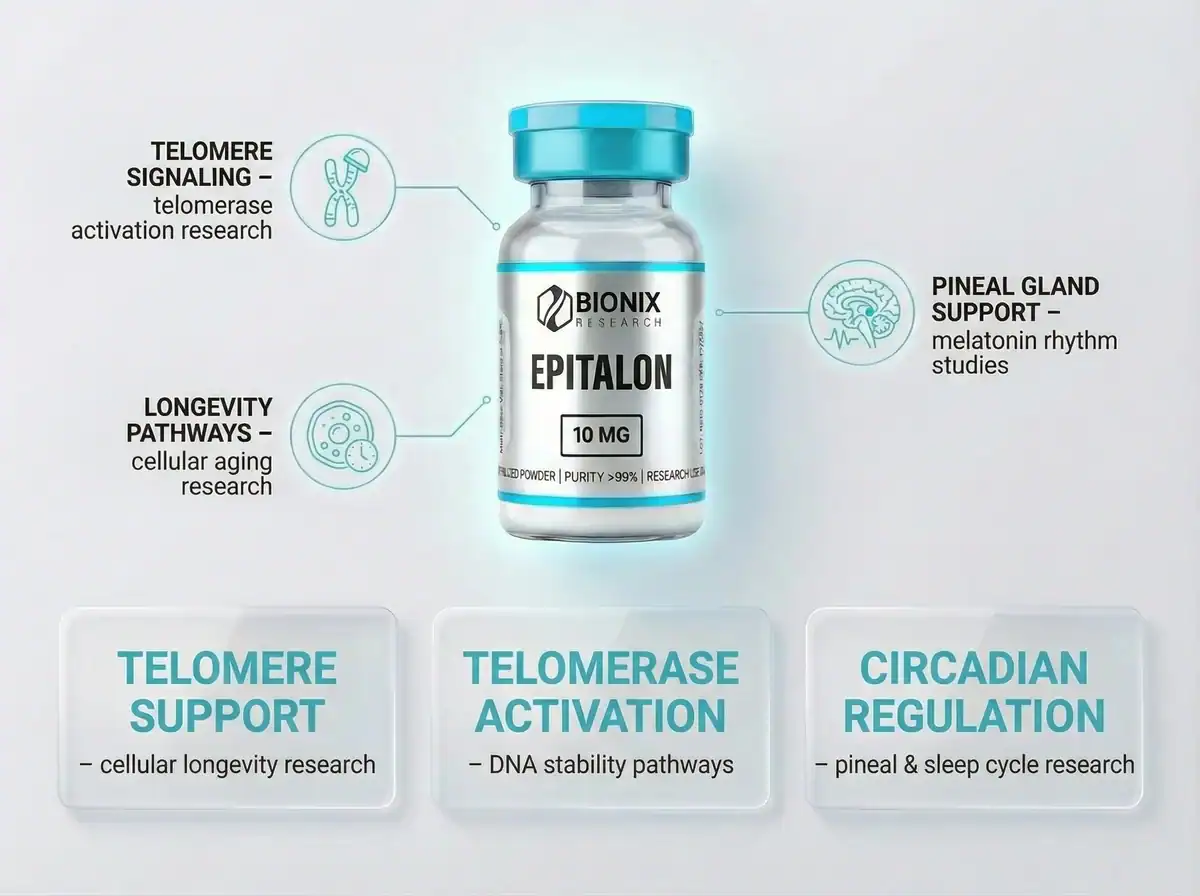
Epithalon: The Telomerase-Activating Peptide in Longevity Research
A comprehensive research guide to the synthetic tetrapeptide targeting telomere biology and pineal gland function.
Epithalon: Key Facts at a Glance
| Aspect | Details |
|---|---|
| What is Epithalon? | A synthetic tetrapeptide (Ala-Glu-Asp-Gly) derived from pineal gland extract Epithalamin |
| Core Function | Activates telomerase enzyme, restores melatonin production, influences cellular aging |
| Research Areas | Longevity & telomere biology, circadian rhythm regulation, immunomodulation |
| Classification | Synthetic bioregulator peptide |
| Unique Feature | Multi-pathway geroprotector targeting 5 hallmarks of aging |
| Research Stage | Preclinical + limited human studies; no large-scale RCTs |
Research Use Only (RUO) Disclaimer:
Epithalon is intended exclusively for scientific research purposes. It is not approved as a pharmaceutical drug in most countries. All information in this article is for educational purposes only and does not constitute medical advice. Any use outside controlled research environments is at the user's own risk and legal responsibility.
The peptide revolution is happening now
Unlock the Advantage: Biological Optimization & Longevity Research Peptides

Epithalon
24,90 € Vialincl. VAT
plus Shipping Costs
Delivery time: 1–6 Working Days
The Cellular Clock: Why Telomeres Matter
Every time a cell divides, it loses a small piece of its protective chromosome ends—the telomeres. After approximately 40-60 divisions, these protective caps become critically short. The cell enters senescence or dies. This is the Hayflick limit, and it represents a fundamental constraint on cellular lifespan.
Epithalon is a synthetic tetrapeptide that activates telomerase—the enzyme capable of rebuilding these protective caps. First isolated from pineal gland extracts by Russian researcher Vladimir Khavinson in the 1980s, Epithalon has since become one of the most studied peptides in longevity research.
In this article, we examine:
- What Epithalon is and its molecular structure
- The dual mechanism: telomerase activation and pineal gland restoration
- Current research across longevity, oncology, and neuroendocrinology
- 2024-2025 research updates
- Safety profile and limitations
- Open questions and research gaps
What is Epithalon?
Chemical Identity
Epithalon (also spelled Epitalon) is a tetrapeptide—a chain of exactly four amino acids. The sequence is:
Ala-Glu-Asp-Gly (AEDG)
This makes it one of the smallest biologically active peptides studied in aging research.
| Property | Value |
|---|---|
| Molecular Formula | C₁₄H₂₂N₄O₉ |
| Molecular Weight | 390.35 g/mol |
| Sequence | Alanine-Glutamic Acid-Aspartic Acid-Glycine |
| CAS Number | 307297-39-8 |
| Form | Lyophilized powder |
| Purity | ≥98% (HPLC-verified) |
| Storage | -20°C long-term |
💡 Key Insight: Epithalon's potency is remarkably high—preclinical studies show effects at microgram doses (µg), compared to milligram doses required for its parent compound Epithalamin.
Origin: From Pineal Gland to Laboratory
Epithalon is the synthetic version of Epithalamin, an extract from the pineal glands (epiphysis) of young calves. The pineal gland is a small, pine cone-shaped structure in the brain, primarily known for producing melatonin—the hormone regulating sleep-wake cycles.
Historical Development:
| Year | Milestone |
|---|---|
| 1980s | Vladimir Khavinson isolates active peptides from calf pineal glands |
| 1990s | Epithalamin tested in animal longevity models |
| Early 2000s | Synthetic AEDG sequence (Epithalon) developed and characterized |
| 2003 | Key telomerase activation study published (Khavinson et al.) |
| 2025 | New mechanistic insights on ALT pathways and cell-type specificity |
The critical distinction:
- Epithalamin = Crude extract containing multiple peptides
- Epithalon = Pure, synthetic AEDG sequence (the active component)
This synthetic form offers consistency, purity, and approximately 500x greater potency than the original extract.
The Telomere Analogy: Shoelace Caps
To understand why Epithalon attracts research interest, consider this analogy:
Telomeres function like the plastic caps (aglets) on shoelaces. They protect the ends of DNA strands (chromosomes) from fraying. With each cell division, these caps shorten slightly. When they become too short, the cell can no longer divide—it ages or dies.
Telomerase is the repair crew that can rebuild these caps. In most adult cells, this enzyme is dormant. Epithalon appears to reactivate it.
Normal aging:
Cell division → Telomere shortening → Hayflick limit → Senescence/Death

With telomerase activation:
Cell division → Telomere maintenance → Extended replicative capacity
How Does Epithalon Work?
Epithalon operates through two primary mechanisms, plus recently discovered secondary pathways.
Mechanism 1: Telomerase Induction (Cellular Rejuvenation)
Epithalon upregulates the hTERT gene—the gene encoding the catalytic subunit of telomerase. This leads to increased telomerase production and subsequent telomere elongation.
The Pathway:
Epithalon administration
    ↓
Binds to TERT gene promoter region
    ↓
Chromatin decondensation → Enhanced gene expression
    ↓
Increased hTERT transcription
    ↓
Elevated telomerase activity
    ↓
Telomere elongation + Extended replicative capacity
2025 Research Update:
A 2025 study examined Epithalon's effects across multiple human cell lines (normal epithelial, fibroblast, and cancer cells). Key findings:
| Cell Type | Telomere Length (Baseline) | Telomere Length (Post-Treatment) | Mechanism |
|---|---|---|---|
| Normal fibroblasts | 2.4 kb | Up to 4.0 kb | Telomerase activation |
| Normal epithelial | Variable | Significant elongation | Telomerase activation |
| Cancer cells (21NT, BT474) | Variable | Extended | ALT pathway (PML bodies) |
💡 Key Insight: Epithalon appears to activate telomerase in normal cells while engaging the Alternative Lengthening of Telomeres (ALT) pathway in certain cancer cell lines—a critical distinction for safety assessment.
Mechanism 2: Pineal Gland Resensitization (Circadian Regulation)
With age, the pineal gland partially calcifies and reduces melatonin output. Epithalon appears to restore pineal function and normalize melatonin secretion.
The Pathway:
Age-related pineal calcification
    ↓
Reduced melatonin synthesis
    ↓
Disrupted circadian rhythm, sleep disturbances
    ↓
Epithalon administration
    ↓
Pineal gland resensitization
    ↓
Restored melatonin production (up to 160% increase in human trials)
    ↓
Normalized circadian rhythm
Human Evidence:
A 2021 trial with 75 women demonstrated:
- 160% increase in melatonin production at 0.5 mg/day vs. placebo
- Improved sleep quality markers
- Normalized circadian biomarkers
This distinguishes Epithalon from peptides like MOTS-c, which primarily target metabolic pathways, or Semax, which focuses on cognitive enhancement and neurotrophic factors.
Mechanism 3: Epigenetic Modulation (Emerging Research)
Recent research suggests Epithalon may influence cellular aging through epigenetic mechanisms beyond telomerase:
| Pathway | Observed Effect | Significance |
|---|---|---|
| Chromatin remodeling | Decondensation of promoter regions | Enhanced gene expression patterns |
| DNA repair | Upregulation of repair mechanisms | Genome stability |
| Clock gene expression | Re-entrainment of circadian genes | Systemic timing coordination |
| Immune modulation | IL-2 mRNA elevation (5 hours vs. 20 hours for other peptides) | Faster immune response |
Mechanism Overview
| Target System | Mechanism | Potential Outcome |
|---|---|---|
| Nucleus/Telomeres | hTERT gene promoter activation | Slowed telomere shortening |
| Pineal Gland | Resensitization, melatonin normalization | Improved circadian rhythm |
| Somatic Cells | Telomerase activation | Increased replicative capacity |
| Epigenome | Chromatin remodeling | Youthful gene expression patterns |
| Immune System | IL-2 pathway stimulation | Enhanced immune function |
Research Areas
Epithalon research spans multiple domains connected to aging biology. Unlike peptides such as GHK-Cu, which are studied primarily for skin regeneration and wound healing, Epithalon's focus lies deeper—at the level of chromosome maintenance and neuroendocrine function.
1. Gerontology (Aging Research)
The most extensive body of Epithalon research examines its effects on lifespan and aging biomarkers.
Animal Model Findings:
| Model | Protocol | Observation | Reference |
|---|---|---|---|
| Swiss-derived SHR mice | 0.1-1 µg/mouse/day, chronic | 13.3% increase in mean lifespan | Anisimov et al., 2003 |
| Rats | Cyclic administration | Delayed age-related pathology | Khavinson et al., 2002 |
| Drosophila | Various protocols | Extended lifespan | Multiple studies |
| Old monkeys | 10 µg/animal/day | Melatonin and telomere restoration | Khavinson research |
Multi-Pathway Geroprotector:
Unlike most anti-aging interventions that target a single pathway, Epithalon appears to address five hallmarks of aging:
- Telomere attrition → Telomerase activation
- Epigenetic alterations → Chromatin remodeling
- Deregulated nutrient sensing → Metabolic normalization
- Cellular senescence → Extended replicative capacity
- Altered intercellular communication → Immune and endocrine modulation
2. Oncology (Cancer Research)
A critical question for any telomerase-activating compound: Does it promote cancer?
Current Evidence:
| Study Type | Finding | Implication |
|---|---|---|
| SHR mice, long-term | 50% reduction in spontaneous tumor incidence | Anti-carcinogenic effect |
| Breast tumor models | Reduced mammary tumor formation | Protective |
| Colon tumor models | Decreased tumor incidence | Protective |
| 2025 cell line study | Telomerase activation in normal cells; ALT pathway in cancer cells | Cell-type specificity |
The Paradox Explained:
Telomerase activation sounds concerning—cancer cells famously use telomerase for immortality. However:
- Epithalon activates telomerase primarily in normal somatic cells (where it's typically dormant)
- In cancer cell lines, it engages the ALT pathway (PML body formation) rather than telomerase
- Long-term animal studies show reduced, not increased, tumor incidence
⚠️ Important Caveat: The ALT pathway elevation in cancer cells requires further investigation. Individuals with active malignancies should not use Epithalon outside supervised research settings.
3. Neuroendocrinology
Epithalon's effects on the pineal gland and hypothalamic-pituitary-adrenal (HPA) axis represent a distinct research avenue.
Key Findings:
- Normalization of melatonin secretion in aging subjects
- Improved sleep architecture in small human trials
- Regulation of cortisol rhythms
- Potential neuroprotective effects (retinitis pigmentosa models)
Human Study (n=14, elderly subjects):
- Normalized melatonin rhythm within treatment period
- Improved subjective sleep quality
- No significant adverse events reported
4. Immunomodulation
Emerging research suggests Epithalon influences immune function:
| Observation | Model | Significance |
|---|---|---|
| IL-2 mRNA elevation in 5 hours | Splenocyte cultures | Faster than comparable peptides (20 hours) |
| Thymic involution delay | Animal models | Preserved immune organ function |
| Enhanced immune cell function | Various | Age-related immune decline mitigation |
Evidence Snapshot
| Research Area | Evidence Level | Key Observation | Reference |
|---|---|---|---|
| Longevity | Animal model (mouse) | 13.3% mean lifespan extension | Anisimov et al., 2003 |
| Oncology | Animal model (mouse) | 50% reduction in tumor incidence with long-term use | Anisimov et al., 2003 |
| Circadian rhythm | Human study (small, n=14) | Melatonin rhythm normalization in elderly subjects | Khavinson et al., 2002 |
| Telomere elongation | In vitro (human cells) | 33-67% telomere elongation in cultured fibroblasts | Khavinson et al., 2003; PMC 2025 |
| Melatonin production | Human RCT (n=75) | 160% increase at 0.5 mg/day | 2021 trial |
| Immune function | In vitro | IL-2 mRNA elevation in 5 hours | Recent studies |
Clinical Development Status
Unlike some peptides with clear pharmaceutical development pathways, Epithalon remains primarily in the research domain.
| Aspect | Status |
|---|---|
| Regulatory approval | Not approved as pharmaceutical in US, EU, or most countries |
| Large RCTs | Not conducted |
| Phase III trials | None |
| Primary research source | St. Petersburg Institute of Bioregulation and Gerontology |
| Independent replication | Limited outside Russian research groups |
| Commercial availability | Research Use Only (RUO) |
Safety Considerations & Limitations
What We Know
Epithalon is a synthetic version of an endogenous peptide—the body produces similar compounds naturally in the pineal gland. Published studies report a favorable safety profile, but significant gaps exist.
Current Safety Data
| Aspect | Status |
|---|---|
| Short-term safety (humans) | No serious adverse events in published trials (n=162 in 2002 study) |
| Reported side effects | Occasional mild headache, fatigue at injection site |
| Long-term safety | Not established |
| Carcinogenicity | No increased tumor incidence in animal longevity studies; reduced tumors observed |
| Drug interactions | Unstudied |
| Pregnancy/Lactation | No data |
Areas Requiring Caution
Cancer Considerations:
- ALT pathway activation observed in certain cancer cell lines
- Individuals with active malignancies should avoid Epithalon
- Those with family history of cancer should consult physicians
Research Limitations:
- Most human studies are small (n<20) and short-term (3-6 months)
- Long-term effects over years or decades are unknown
- Optimal dosing protocols not established
Geographic Research Concentration:
- Majority of research originates from one Russian institution
- Independent Western replication is limited
- Publication primarily in Russian journals with varying peer review standards
Open Questions in Epithalon Research
1. Long-Term Human Effects
Most human studies span 3-6 months with fewer than 20 subjects. Effects over years or decades remain unknown. Does telomerase activation persist? Are there cumulative effects or risks?
2. Independent Replication
The bulk of Epithalon research comes from Khavinson's group at the St. Petersburg Institute. Large-scale, multicenter trials following Western standards (Phase III equivalent) have not been conducted. Independent replication is essential for scientific validation.
3. Optimal Protocols
Published studies use varying dosages (1-10 mg), frequencies (daily vs. cyclic), and durations. No consensus exists on:
- Optimal dose for different endpoints
- Cyclic vs. continuous administration
- Treatment duration
- Maintenance protocols
4. Cell-Type Specificity
The 2025 finding that Epithalon activates telomerase in normal cells but ALT pathways in cancer cells requires deeper investigation:
- What determines pathway selection?
- Are there cell types where this distinction fails?
- What are the implications for individuals with pre-malignant conditions?
5. Interaction with Other Longevity Interventions
How does Epithalon interact with:
- Rapamycin/mTOR inhibitors
- NAD+ precursors
- Senolytics
- Caloric restriction
These questions remain unanswered.
Preclinical Research Protocols
The following information is provided for research reference only. These are protocols from published studies—not recommendations.
| Study Type | Model | Protocol | Reference |
|---|---|---|---|
| Longevity | Mouse | 0.1-1 µg/mouse/day, chronic or cyclic | Anisimov et al., 2003 |
| Telomere elongation | Human cell culture | 0.2-1 µg/ml, 4 days | PMC 2025 |
| Melatonin restoration | Human trial | 0.5 mg/day | 2021 trial |
| Pineal function (primates) | Old monkeys | 10 µg/animal/day | Khavinson research |
Note: Animal dosing does not translate directly to humans. Allometric scaling and pharmacokinetic differences make cross-species extrapolation unreliable without specific study data.
Research Context & Limitations
The observations described in this article come from preclinical models, in vitro studies, and limited human trials. Large-scale clinical studies on efficacy and safety are pending. All findings should be interpreted within the experimental research context.
| Evidence Level | Status |
|---|---|
| In vitro (cell studies) | Extensive |
| Preclinical (animal models) | Strong foundation, primarily Russian sources |
| Human biomarker studies | Limited, small sample sizes |
| Human intervention trials | Small trials only (largest n=162) |
| Long-term safety data | Not available |
| Independent replication | Limited |
Epithalon represents a compelling molecule in basic aging research. The concept of reactivating telomerase to extend cellular lifespan addresses a fundamental constraint on cell division. However, the research base requires expansion—particularly through independent replication and larger human trials.
Summary
Epithalon is a synthetic tetrapeptide (AEDG) that activates telomerase and restores pineal gland function. Research shows promising results in animal models and small human studies—particularly for longevity and circadian rhythm regulation.
| Aspect | Summary |
|---|---|
| Identity | Synthetic tetrapeptide (Ala-Glu-Asp-Gly), 390.35 Da |
| Origin | Laboratory synthesis of active sequence from pineal extract Epithalamin |
| Primary Mechanisms | Telomerase activation via hTERT; pineal gland resensitization |
| Secondary Mechanisms | Epigenetic modulation; immune enhancement (IL-2) |
| Research Highlights | 13.3% lifespan extension (mice); 33-67% telomere elongation (in vitro); 160% melatonin increase (human trial) |
| Safety | Favorable in published studies; long-term data lacking; cancer cell ALT activation requires investigation |
| Limitations | Most research from single institution; no large RCTs; optimal protocols undefined |
The data are promising, but the scientific foundation requires strengthening through independent replication and controlled long-term studies.
The peptide revolution is happening now
Unlock the Advantage: Biological Optimization & Longevity Research Peptides
Epithalon
24,90 € Vialincl. VAT
plus Shipping Costs
Delivery time: 1–6 Working Days
Frequently Asked Questions (FAQ)
What is Epithalon?
Epithalon is a synthetic tetrapeptide consisting of four amino acids (Alanine-Glutamic Acid-Aspartic Acid-Glycine, or AEDG). It stimulates telomerase activity and influences pineal gland function. It is the laboratory-synthesized version of the active sequence found in Epithalamin, a pineal gland extract.
Does Epithalon actually elongate telomeres in humans?
In cell culture experiments with human fibroblasts, telomere elongation of 33-67% has been observed. A 2025 study confirmed dose-dependent elongation across multiple human cell lines. However, controlled long-term studies in living humans confirming this effect are pending.
Is Epithalon the same as Epithalamin?
No. Epithalamin is a crude extract from calf pineal glands containing a mixture of various peptides. Epithalon is the synthetically produced, pure form of the active sequence (AEDG). Epithalon is approximately 500x more potent than Epithalamin on a per-weight basis.
What role does the pineal gland play in Epithalon's effects?
The pineal gland produces melatonin and regulates the sleep-wake cycle. With age, it partially calcifies and reduces melatonin output. Epithalon appears to resensitize this gland—restoring its age-related declining function. Human trials show up to 160% increase in melatonin production.
Are there known side effects in Epithalon research?
Published studies report minimal side effects. Occasionally, mild headaches or fatigue occurred shortly after injection. No serious adverse events have been documented in trials. However, long-term side effects are unknown, and the largest published study included only 162 subjects.
Why isn't Epithalon research more widely known?
The majority of research was conducted in Russia and published in Russian scientific journals. Additionally, large multicenter studies meeting Western standards (Phase III) are lacking. Independent replication by research groups outside Russia remains limited.
Does Epithalon cause cancer?
This is a critical question for any telomerase-activating compound. Current evidence suggests Epithalon does not increase cancer risk—in fact, long-term animal studies show reduced tumor incidence (50% reduction in one model). A 2025 study found that Epithalon activates telomerase in normal cells but engages a different pathway (ALT) in cancer cells. However, individuals with active malignancies should avoid Epithalon, and this area requires further research.
How does Epithalon compare to other longevity peptides?
Epithalon is unique in its telomerase-focused mechanism. While MOTS-c targets mitochondrial function and AMPK activation, and NAD+ precursors focus on sirtuin pathways, Epithalon directly addresses telomere attrition—one of the nine hallmarks of aging. It also uniquely combines telomere effects with pineal gland restoration.
Is Epithalon FDA-approved?
No. Epithalon is not approved as a pharmaceutical drug in the United States, European Union, or most other countries. It is available for research purposes only (RUO). No large-scale clinical trials have been submitted for regulatory approval.
Glossary
| Term | Explanation |
|---|---|
| ALT (Alternative Lengthening of Telomeres) | A telomerase-independent mechanism for telomere maintenance, primarily observed in some cancer cells |
| Epithalamin | Crude extract from calf pineal glands—the natural precursor from which Epithalon was derived |
| Geroprotector | A substance that targets aging processes to extend healthspan or lifespan |
| Hayflick Limit | The maximum number of cell divisions (~40-60) a cell can undergo before senescence or death |
| hTERT | Human Telomerase Reverse Transcriptase—the gene encoding the catalytic subunit of telomerase |
| Melatonin | Hormone produced by the pineal gland that regulates sleep-wake cycles |
| Peptide | A short chain of amino acids, the building blocks of proteins |
| Pineal Gland | Also called epiphysis; a small brain structure producing melatonin and regulating circadian rhythm |
| PML Bodies | Promyelocytic Leukemia bodies; nuclear structures associated with ALT pathway |
| Telomerase | An enzyme that can rebuild telomeres; dormant in most adult cells |
| Telomere | Protective end caps of chromosomes; shorten with each cell division and determine cellular biological age |
| Tetrapeptide | A peptide consisting of exactly four amino acids |
References
Khavinson VK et al. (2002). "Peptides and Ageing." Neuro Endocrinol Lett, 23(3):144-6. PMID: 12146315
Khavinson VK et al. (2003). "Epithalon peptide induces telomerase activity and telomere elongation in human somatic cells." Bull Exp Biol Med, 135(6):590-2. PMID: 12937682
Anisimov VN et al. (2003). "Effect of Epitalon on biomarkers of aging, life span and spontaneous tumor incidence in female Swiss-derived SHR mice." Biogerontology, 4(4):193-202. PMID: 12577695
"Epitalon increases telomere length in human cell lines." PMC, 2025. PMC12411320
Khavinson V, Linkova N, Dyatlova A, Kuznik B, Umnov R. "Short Peptides: Regulation of Aging." Front Genet. 2020.
Khavinson VKh, Malinin VV. "Gerontological aspects of genome peptide regulation." Karger Publishers, 2005.
St. Petersburg Institute of Bioregulation and Gerontology. Multiple publications 1990-2025.
Research Use Only (RUO) Disclaimer: Epithalon is intended exclusively for scientific research purposes. It is not approved as a pharmaceutical drug in most countries. All information in this article is for educational purposes only and does not constitute medical advice. Any use outside controlled research environments is at the user's own risk and legal responsibility.
Disclaimer: The information provided on this blog is for general information and educational purposes only. It does not constitute professional advice (e.g., medical advice). Content relating to research results, studies, or scientific findings reflects the status at the time of publication. As research is constantly evolving, no guarantee can be given for the timeliness, accuracy, or completeness of the cited data and conclusions. Use of the content is at your own risk.

